Pocket Fit vs Cal AI: the photo is the easy part
Cal AI's own FAQ says the app is "about 80% accurate", and it is still right about the camera. What decides your result is the minute after the photo, and that is where the two apps stop being comparable.
13 min readUpdated September 2026
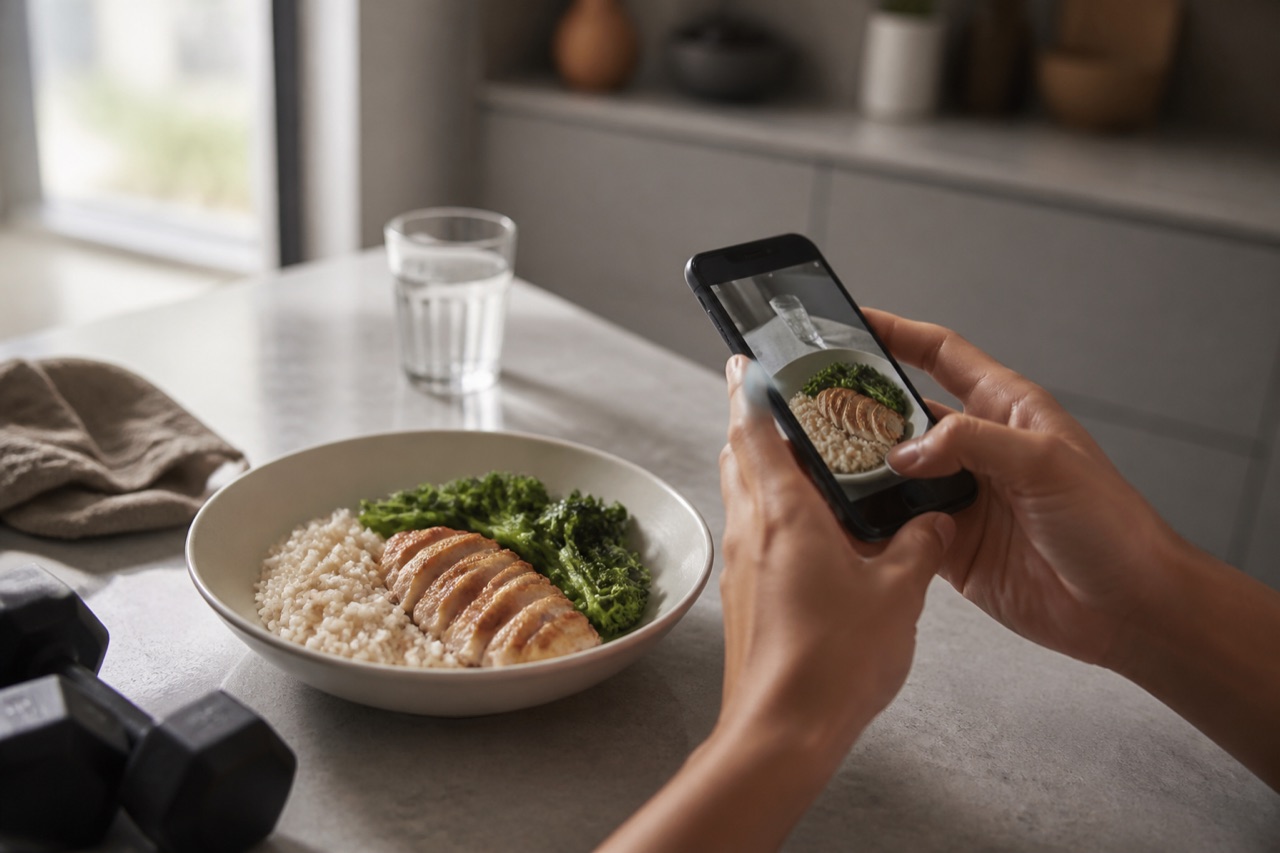
You are standing over a plate of something you did not weigh, in a kitchen that is not yours, with about eight seconds before logging it stops feeling worth the effort. Cal AI is built for exactly that moment. Point the camera, get a number, eat. There is a reason it went from a high school project to fifteen million downloads in under two years, and it is not marketing alone. It removed the most annoying step in food tracking.
The reasonable assumption is that whoever removes the most friction wins. That is close to true, and we build on the same assumption. What it misses is that the cost of one entry and the usefulness of that entry are different problems. A ten-second photo landing in an app that does not know you are squatting tomorrow is a cheap number with nowhere to go. For the wide-angle version across six apps, read our best food tracking app comparison. This piece is the narrow head to head.
Our bias, stated first
We make Pocket Fit. This article exists partly to sell it, and you should read it with that filter on.
What we can do is make it checkable. Every factual claim about Cal AI below comes from its own website, its own FAQ, its store listing, or the two primary sources on the MyFitnessPal acquisition, read in August 2026. Where a company does not publish something, we say so instead of guessing.
One honesty tax paid up front. Cal AI is better than us at getting a complete beginner to log anything at all. Its whole product is one gesture, and it has convinced a very large number of people who would never open a food database to start tracking. That is a real achievement and no feature table cancels it out.
The short answer
These apps answer different questions, which is why comparing them line by line feels slippery.
Cal AI answers "what did I just eat". It is a photo-first calorie estimator that also does barcodes and text descriptions, now owned by MyFitnessPal but still running standalone. Pocket Fit answers "what should I do about it". Fuel is our nutrition tool, and it sits inside a training app that already knows your programme, your week and your recovery.
Choose Cal AI if the only version of tracking you will genuinely do is pointing a camera at a plate, and you accept an estimate rather than a measurement.
Choose Pocket Fit if you train, and the reason you track is protein on a cut or fuelling a heavy session, so the food log and the training plan need to be looking at the same person.
Pocket Fit vs Cal AI side by side
Everything here comes from each company's own website, FAQ or store listing, read in August 2026, plus the two cited acquisition sources. Prices vary by region and promotion.
Two rows deserve a note. Cal AI does not publish a clear price on its public site, which is unusual in this category, and we are not going to invent one for you. Pocket Fit's launch bundle is a limited arrangement rather than a permanent promise.
Cal AI: the cleanest expression of the photo-first idea
Cal AI is the app that made the rest of the category rebuild its camera.
What it genuinely does well. The pitch on its homepage is one sentence long: snap a photo, scan a barcode, or describe your meal, and get instant calorie and nutrient info. There is almost nothing to learn. The site explains the mechanism plainly, saying your phone's depth sensor calculates food volume and the AI then analyses the meal into calories, protein, carbohydrate and fat. It carries high ratings on the App Store at the time of writing.
What it is honest about. Its FAQ contains a sentence most competitors would never publish: "CalAI is about 80% accurate. No food tracking app is perfect, and calories and nutrition values can vary." We respect that far more than a marketing page claiming precision.
What changed in 2026. MyFitnessPal acquired Cal AI in a deal that closed in December 2025 and was announced on 2 March 2026. TechCrunch reports the app stays independent with the same mission, that its seven-person team was retained, and that Cal AI users have already been given access to MyFitnessPal's nutrition database. Terms were not disclosed and we are not going to guess at a price. The practical read is that Cal AI's weakest point, the long-tail branded lookup, just got solved for it.
Where friction lives. Everything after the photo. Cal AI knows what you ate. It does not know that you deadlifted last night, that you slept five hours, or that Thursday is your heavy session. That is not a flaw in their product, it is the boundary of it.
Pocket Fit Fuel: one entry per food, and the training beside it
Fuel is the nutrition side of Pocket Fit. It tracks protein, carbohydrate and fat against targets with several entry paths, and it is deliberately not trying to win on database size. We do not claim the biggest catalogue and we never will.
One entry per distinct food. Photograph a plate and Fuel proposes a separate line for the chicken, the rice and the broccoli, with alternatives if the first guess is wrong, rather than one blurred total you cannot correct. When the model is wrong about one item, you fix one item. For getting the most out of that path, read how to log food with a photo.
Barcode scan is not paywalled. Paywalling the fastest path is how apps teach people to stop logging. Ours stays open.
Templates and copy-meal. Most diets are far more repetitive than they look. The twenty-first bowl of porridge should cost two taps, not another camera session. That is the part a photo-only app cannot give you.
Targets from your profile. Calories, protein and fat are derived by formula from your profile at programme generation, so food and training share one picture of you rather than two. Going over is information about tomorrow, not a verdict about you, so Fuel has no red numbers.
Body budget. The Body budget keeps one running tally across four deposits: your workout, your streak, your sleep and your nutrition. A heavy leg day and a rest day are not handed the same number, and when your lifts stall the app has food and sleep on file rather than sets alone.
What a photo can honestly do
This is the section where we argue against our own feature, so read it carefully.
Shonkoff and colleagues, in a systematic review in Annals of Medicine covering 52 papers, compared AI-based digital image dietary assessment against humans and ground truth. Calorie errors ranged from 0.10% to 38.3% across studies, and the results were too heterogeneous to pool into a single figure. Error was smaller for single simple foods and larger for several foods piled together.
Both halves of that range matter. At the good end, a photo of one plain food is close enough that arguing about it wastes your evening. At the bad end, a mixed dish with oil you did not see is out by more than a third. Cal AI's "about 80% accurate" sits inside that range and reads as fair self-description rather than a boast.
The conclusion is not that photo logging is bad. It is that the number on the screen is an estimate, and a consistent estimate you record daily beats a precise one you abandon. The longer version is in how accurate are photo calorie apps.
Where the evidence runs thin
Now the caveats, including the ones that hurt us.
Nobody has tested these apps head to head. There is no trial comparing Cal AI against Pocket Fit for weight loss. Everything above is a product comparison plus general evidence about photo estimation and adherence. Anyone claiming an app is "clinically proven" to beat another one in this category is selling something.
The accuracy picture may be worse than the headline. Fridolfsson and colleagues, in Current Developments in Nutrition in 2025, tested three large language models against weighed references and found mean absolute energy errors of 35.8% to 64.2%, with protein errors from 60.7% to 109.9% and a tendency to underestimate larger portions. Different method, not a test of any shipping consumer app, but it is the direction an honest reader should weight.
"80% accurate" is not a defined measurement. Cal AI does not publish the method behind it. We publish no accuracy figure at all, which is not better, just quieter.
Our own claims are self-reported. The seconds-per-entry argument for templates is our design reasoning, not a controlled study. Treat it as a hypothesis you can test in a fortnight of real weeks.
Who should buy which
Buy Cal AI if you want a calorie estimate and nothing else, if the camera is the only interface you will tolerate, and if your realistic alternative is not tracking at all.
Buy Pocket Fit if you lift or want a programme, if you track because of protein on a cut or fuelling a hard session, and if you have run a food app and a gym app side by side and noticed they never talk.
Use both only if you accept the admin and stay disciplined about not double-counting. For most people that is a phase, not a setup.
Do not buy Cal AI expecting it to programme your squats. Do not buy Pocket Fit expecting it to be a purer camera than the app that defined the category.
Put it together
The interesting number in this comparison is not accuracy. It is duration. Turner-McGrievy and colleagues, in the Journal of the Academy of Nutrition and Dietetics, analysed dietary self-monitoring across two six-month mobile weight loss trials with 124 adults and found that every adherence measure they examined had fewer than half the sample still tracking after week 10.
That is the real competition. Cal AI attacks it by making the first entry almost free, which is a legitimate and effective answer. We attack it from the other side: make the repeat entry nearly free with templates, refuse to paywall the barcode, remove the red numbers that make people quit in shame, and give the log somewhere to go through the Body budget. If your food data never changes what you do on Thursday, logging is admin. If it does, it is training. The same logic drives our Pocket Fit versus MyFitnessPal comparison.
Pocket Fit exists because of the bad weeks, not the good ones. Georgi built it after going from 122 kg to winning first place at The Yard Games, having lost 38 kg on the way, and the app is shaped around the days when the plan wobbles rather than the days it works. That is our story.
Pocket Fit vs Cal AI: common questions
Is Pocket Fit better than Cal AI?
Not in general. Cal AI is better at one gesture: point a camera, get a number, move on. Pocket Fit is better if you train, because Fuel sits beside a programme and the Body budget, so the log changes what you do next. If you only want calorie estimates, Cal AI is the purer tool.
How accurate is Cal AI?
Its own FAQ says "CalAI is about 80% accurate. No food tracking app is perfect." That sits inside the range found by the Annals of Medicine systematic review of 52 papers, which reported calorie errors from 0.10% to 38.3%, with bigger errors on mixed dishes than single foods. No photo app on the market is a measuring instrument, ours included.
How much does Cal AI cost?
Cal AI does not publish a clear price on its public website at the time of writing. It promotes a 3-day free trial, and its store listing carries in-app purchases with food scanning requiring a subscription. Check the store for the current figure rather than trusting any article, including this one. Pocket Fit is £9.99 a month or £59.99 a year.
Is Cal AI still independent after the MyFitnessPal acquisition?
It runs as a standalone app. MyFitnessPal announced the acquisition on 2 March 2026 for a deal that closed in December 2025, and both TechCrunch and the MyFitnessPal release state Cal AI continues as a separate product with access to MyFitnessPal's food database. Terms were not disclosed.
Does Pocket Fit have a barcode scanner?
Yes, and it is not behind a premium tier. Fuel also offers photo logging with one entry per distinct food, nutrition-label scanning, search and meal templates, with food included in the workout membership for a limited launch period.
References
- Shonkoff E, Cara KC, Pei X, Chung M, Kamath S, Panetta K, Hennessy E (2023). AI-based digital image dietary assessment methods compared to humans and ground truth: a systematic review. Annals of Medicine, 55(2), 2273497. DOI: 10.1080/07853890.2023.2273497
- Turner-McGrievy GM, Dunn CG, Wilcox S, Boutté AK, Hutto B, Hoover A, Muth E (2019). Defining adherence to mobile dietary self-monitoring and assessing tracking over time. Journal of the Academy of Nutrition and Dietetics, 119(9), 1516-1524. DOI: 10.1016/j.jand.2019.03.012
- Fridolfsson J, Sjöberg E, Thiwång M, Pettersson S (2025). Performance evaluation of 3 large language models for nutritional content estimation from food images. Current Developments in Nutrition, 9(10), 107556. DOI: 10.1016/j.cdnut.2025.107556
- TechCrunch (2 March 2026). MyFitnessPal has acquired Cal AI, the viral calorie app built by teens. techcrunch.com
- MyFitnessPal (2 March 2026). MyFitnessPal Acquires Cal AI, Expanding on its Position as the Leading Player in Digital Nutrition Tracking. GlobeNewswire. globenewswire.com
- Cal AI official website, including its product description and frequently asked questions, calai.app, accessed August 2026.
Pocket Fit is a fitness and wellbeing app, not a medical device. It does not diagnose, treat or prevent any condition. Always consult a qualified healthcare professional before starting or changing a training or nutrition programme, and if you have persistent problems with sleep, pain or fatigue. Georgi, founder of Pocket Fit. He went from 122 kg to winning first place at The Yard Games, having lost 38 kg along the way.
Related articles
Free tools
Train smarter with Pocket Fit
Download the app