How accurate are photo calorie apps, honestly
A photo cannot see the oil in the pan. Photo calorie apps are useful for adherence, not laboratory precision - and that distinction decides whether they help you.
10 min readUpdated August 2026
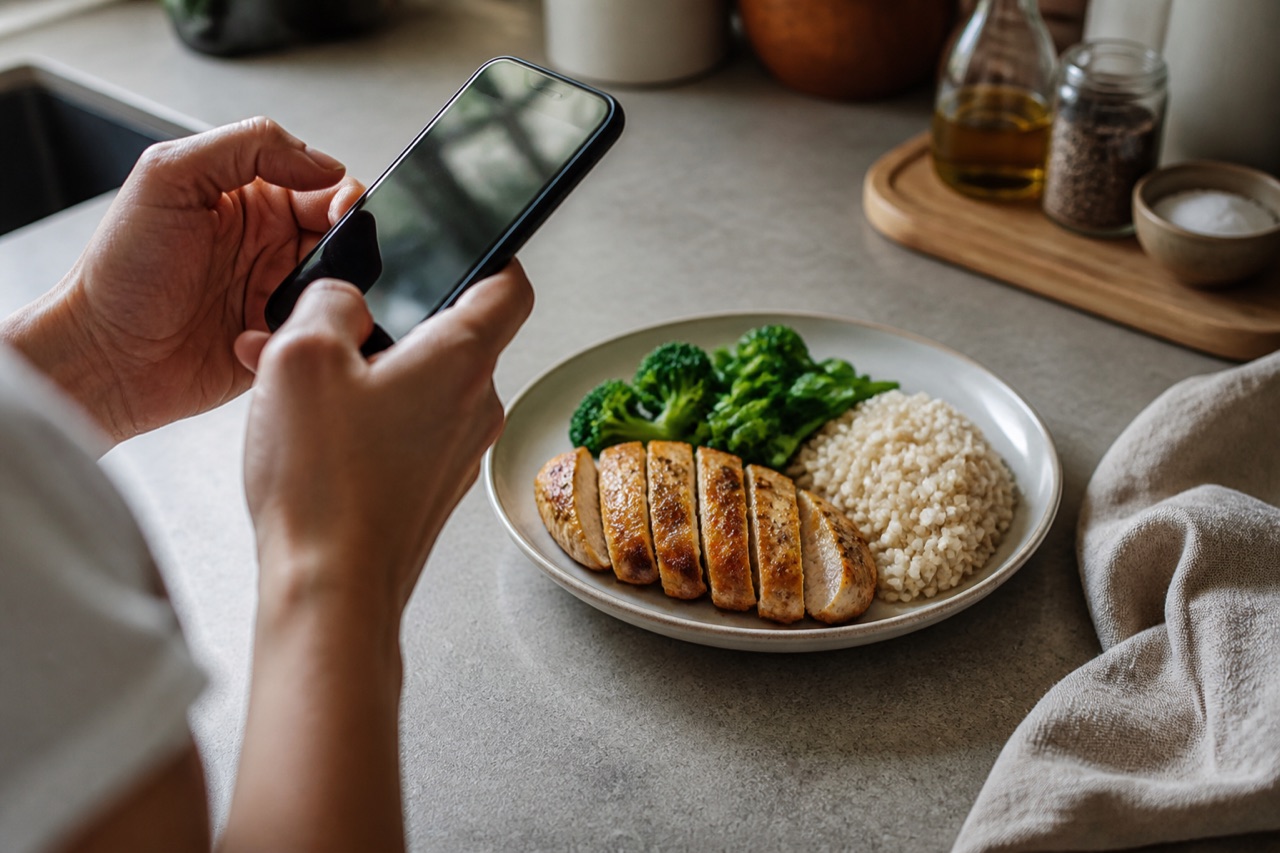
You photograph the plate. The app thinks for two seconds, then hands you a number with three decimal places and a confidence badge that looks like a laboratory readout. Then you remember the tablespoon of olive oil you swirled in the pan before the chicken went in, and the reassurance evaporates.
The reasonable assumption is that the app is wrong, and that proper calorie counting means weighing everything. That assumption is half right. Photo calorie apps are not precision instruments. They are also not competing with a weighed record on most days. They are competing with not logging at all.
The research on food tracking is blunt about which contest decides your result. This article is about photo calorie app accuracy in that light: what the apps claim, what human logging gets wrong, what a camera can and cannot see, and where a photo-first tool is the right answer rather than the wrong one.
What photo calorie apps claim
Every listing in this category makes the same promise. Point your camera, get calories and macros in seconds, no database search, no kitchen scale.
The screenshots always show a clean plate: a fillet, rice, a few green things. They never show the curry where the chicken is buried, the canteen tray with gravy underneath, or the bowl you ate standing at the counter because you were late. That gap between the marketing plate and your actual plate is the whole argument about accuracy.
How wrong self-reporting is, before you blame the camera
Before you judge a photo estimate, look at what it is replacing.
Burke, Wang and Sevick reviewed the self-monitoring literature for the Journal of the American Dietetic Association, covering 22 studies, of which 15 looked specifically at dietary self-monitoring. They found a significant association between self-monitoring and weight loss consistently across the studies. They were also careful: the authors state plainly that the level of evidence was weak because of methodological limitations, the samples were predominantly white and female, and most of the work predates smartphones.
Turner-McGrievy and colleagues, in the Journal of the Academy of Nutrition and Dietetics, analysed self-monitoring data from two six-month mobile weight loss trials with 124 adults. Every adherence measure they examined had fewer than half the sample still tracking after week 10. Days on which someone tracked at least two eating occasions explained the most variance in six-month weight loss, with an R squared of 0.27.
Human logs are not only abandoned. They are wrong while they last. Lichtman and colleagues, in the New England Journal of Medicine, found motivated obese subjects underreported intake by 47%. Freedman and colleagues pooled five biomarker validation studies and found average underreporting of 28% with a food frequency questionnaire and 15% with a single 24-hour recall.
A weighed record is more precise than a photo when you actually do it. Most people do not, and the people who do still forget the oil. The photo is not competing with a perfect human log. It is competing with a partial one, or with silence. For the wider seconds-per-entry argument, read our best food tracking app comparison.
What a photo can and cannot see
A photo app recognises foods first, then estimates portions. Recognition is the reliable step. Portion is where honesty is required.
Shonkoff and colleagues, in a systematic review in Annals of Medicine covering 52 papers, found calorie errors ranging from 0.10% to 38.3% across studies, too heterogeneous to pool. Error was smaller for single, simple foods and larger for multiple foods piled together.
Fridolfsson and colleagues, in Current Developments in Nutrition, compared three large language models against weighed references. Mean absolute energy errors ran from 35.8% to 64.2%, with protein errors from 60.7% to 109.9%, and a tendency to underestimate larger portions.
What a photo reads well: grilled protein beside plain starch and vegetables; repeat meals; foods with visible edges.
What it reads badly: cooking fat added off-camera; mixed dishes with hidden ingredients; deep bowls; restaurant food with unknown prep.
The oil in the pan is the honest example. A camera sees gloss on the chicken. It does not see whether that gloss came from a teaspoon or a tablespoon. The correct mental model is not "the app knows". It is "the app proposes, and you sanity-check".
Adherence versus precision
Precision is how close a logged number is to laboratory truth. Adherence is how many days you actually log. The research says adherence collapses before precision gets a chance to matter.
A photo that is 30% out on a mixed plate but logged in ten seconds beats a weighed record you skipped because you were eating with other people. The winning input is the one you are still using in week six when lunch happens in front of colleagues.
That does not make accuracy irrelevant. It reframes the job. Your log is an instrument panel, not a receipt. Compare this week to last week. Notice whether protein drifts down on training days. The absolute kcal total is less trustworthy than the direction.
When photo logging helps
It helps when you would otherwise skip the meal; the plate is visually simple; speed is the binding constraint; you are building a repeat-meal habit; your goal is directional rather than clinical.
It helps less when the meal is a sauced, mixed restaurant dish and you need the exact number; you are on a protocol that demands weighed intake; the food is packaged and has a barcode; or logging makes you anxious rather than informed.
For the practical how-to, read how to log food with a photo. For database versus seconds per entry, read Pocket Fit vs MyFitnessPal.
Where Pocket Fit Fuel sits
Fuel is the nutrition tool inside Pocket Fit. We ship photo logging, and we are not pretending it is a laboratory assay.
The design choice that matters is one entry per distinct food, not one blurred meal total. Photograph a plate and Fuel proposes separate lines for chicken, rice and vegetables, with alternatives if the first guess is wrong. Separating foods does not eliminate hidden oil, but it lets you correct the line that is off without re-entering the whole meal.
Barcode, nutrition-label scan, search, templates and copy-meal sit one tap away for the cases where a photo is wrong. Targets are computed from your profile at programme generation time, so food and training share one picture of you. No red numbers. Meals feed the Body budget, the running tally across your workout, your streak, your sleep and your nutrition.
We are not claiming the biggest database. We are claiming lower seconds per entry on repeat meals, and one app for food and lifting. Check pricing for current terms.
Where the evidence runs thin
The photo accuracy literature is young, heterogeneous and mostly not about the exact apps on your phone today. Burke, Wang and Sevick rated the self-monitoring evidence weak. Turner-McGrievy and colleagues followed 124 adults in weight loss trials, not every population. None of this tells a lifter exactly how many grams of protein they ate last night. It tells you what class of tool this is: useful for behaviour, risky to treat as metrology.
We sell Pocket Fit and we ship the feature we are criticising. If an app promises gram-perfect photo logging, it is overselling. If it promises nothing, you will not log. The defensible position is fast enough to keep doing, honest enough to correct.
Put it together
Photo calorie apps are not accurate the way a scale is accurate. They are accurate enough to be useful the way a map is useful: not because every side street is perfect, but because having a map beats wandering.
Burke, Wang and Sevick linked self-monitoring to better weight outcomes, with caveats. Turner-McGrievy and colleagues showed fewer than half the sample still tracking after week 10. The behaviour matters, and the behaviour dies when logging is slow or embarrassing.
A photo cannot see the oil in the pan. It also cannot see the meal you never logged because search took a minute. For most people, most days, the second failure is the larger one.
Use the photo where it wins. Use a barcode where one exists. Correct the portion with one glance. Compare weeks, not absolute totals. And if you lift, keep food in the same app as training.
Georgi built Pocket Fit after the weeks where tracking felt like punishment and quietly stopped. He went from 122 kg to winning first place at The Yard Games, losing 38 kg along the way. Read our story.
Photo calorie app accuracy: common questions
How accurate are photo calorie apps?
Not laboratory accurate. A systematic review in Annals of Medicine found calorie errors from 0.10% to 38.3% across 52 studies. A 2025 validation study against weighed references found mean absolute energy errors of 35.8% to 64.2%. Useful for logging consistently; not for treating the number as exact.
Are photo calorie apps better than manual logging?
They are faster, which matters more than precision for most people. Turner-McGrievy and colleagues found fewer than half the sample still tracking after week 10. A photo estimate you log beats a manual search you skip.
Why do photo calorie apps get calories wrong?
Most error is portion and hidden ingredients, not identification. Cameras cannot see off-screen oil, sauce in a mixed dish, or depth inside a bowl. Treat the app as a first draft you sanity-check.
When should I use a photo instead of a barcode?
Photo for simple home-cooked plates when speed matters. Barcode for anything packaged. For mixed restaurant meals, photograph then correct, or search the dish by name.
Does Pocket Fit use photo calorie counting?
Yes, through Fuel: one entry per distinct food with alternatives, plus barcode, label scan, search and templates. Read how to log food with a photo for the walkthrough.
References
- Burke LE, Wang J, Sevick MA (2011). Self-monitoring in weight loss: a systematic review of the literature. Journal of the American Dietetic Association, 111(1), 92-102. DOI: 10.1016/j.jada.2010.10.008
- Turner-McGrievy GM, Dunn CG, Wilcox S, Boutté AK, Hutto B, Hoover A, Muth E (2019). Defining adherence to mobile dietary self-monitoring and assessing tracking over time. Journal of the Academy of Nutrition and Dietetics, 119(9), 1516-1524. DOI: 10.1016/j.jand.2019.03.012
- Lichtman SW, Pisarska K, Berman ER, Pestone M, Dowling H, Offenbacher E, Weisel H, Heshka S, Matthews DE, Heymsfield SB (1992). Discrepancy between self-reported and actual caloric intake and exercise in obese subjects. New England Journal of Medicine, 327(27), 1893-1898. DOI: 10.1056/NEJM199212313272701
- Freedman LS, Commins JM, Moler JE, Arab L, Baer DJ, Kipnis V, Midthune D, Moshfegh AJ, Neuhouser ML, Prentice RL, Schatzkin A, Spiegelman D, Subar AF, Tinker LF, Willett W (2014). Pooled results from 5 validation studies of dietary self-report instruments using recovery biomarkers for energy and protein intake. American Journal of Epidemiology, 180(2), 172-188. DOI: 10.1093/aje/kwu116
- Shonkoff E, Cara KC, Pei X, Chung M, Kamath S, Panetta K, Hennessy E (2023). AI-based digital image dietary assessment methods compared to humans and ground truth: a systematic review. Annals of Medicine, 55(2), 2273497. DOI: 10.1080/07853890.2023.2273497
- Fridolfsson J, Sjöberg E, Thiwång M, Pettersson S (2025). Performance evaluation of 3 large language models for nutritional content estimation from food images. Current Developments in Nutrition, 9(10), 107556. DOI: 10.1016/j.cdnut.2025.107556
Pocket Fit is a fitness and wellbeing app, not a medical device. It does not diagnose, treat or prevent any condition. Always consult a qualified healthcare professional before starting or changing a training or nutrition programme, and if you have persistent problems with sleep, pain or fatigue. Georgi, founder of Pocket Fit. He went from 122 kg to winning first place at The Yard Games, having lost 38 kg along the way.
Related articles
Free tools
Train smarter with Pocket Fit
Download the app