Pocket Fit vs Apple Fitness+, Strava and Peloton: these four are not competing for the same job
Apple Fitness+ sells you 12 workout types, Strava sells you segments, Peloton sells you instructors, and not one of the three will tell you what to put on the bar on Thursday. Strength is a dose measured in 30 to 60 minutes a week, and a dose is not a class.
15 min readUpdated September 2026
You have four tabs open and they cost roughly the same, so you are comparing them feature by feature. Class library. Star ratings. Monthly price. Whether it works on the Watch. Somewhere in the third tab the columns stop lining up, and you decide that is a presentation problem.
It is a category problem. The reasonable assumption is that these are four versions of one product, a fitness subscription, and that one of them is best. They are four different products sold at similar prices in the same aisle. Apple Fitness+ is filmed classes with a schedule on top. Strava is a social record of where you ran and rode. Peloton is instructor-led classes, built originally around hardware. Pocket Fit is a strength programme engine with food attached.
So the expensive mistake is not picking the wrong one. It is buying one expecting another one's job, then deciding after six weeks that fitness apps do not work.
Our bias, stated first
We make Pocket Fit. We sell a subscription. This article exists partly to sell it, so treat every sentence about us as a claim from an interested party.
The rest is checkable. Every factual claim about Apple Fitness+, Strava and Peloton comes from that company's own website or help centre, read in August 2026, with sources at the end. Where prices vary by region or load dynamically, we say check the site rather than print a number we cannot stand behind.
Now the honesty tax, because a comparison that concedes nothing is an advert with footnotes. Apple Fitness+ is better value than us for a household: Apple's UK page lists £9.99 a month or £79.99 a year, shareable with up to five family members who each get their own personalised experience. Strava is better at motivation than any of us, because the feed and the leaderboards do something to human behaviour that no programme engine does. Peloton has the best instructors in consumer fitness, and it is not close.
The short answer: four products, four different jobs
Choose Apple Fitness+ if you want to be led through a good workout on a screen, you live inside the Apple ecosystem, and you would rather follow than plan.
Choose Strava if your training is running or cycling and you care about pace, routes, segments and who else has done them.
Choose Peloton if the instructor is what gets you moving, or you own Peloton hardware, in which case app access comes with the All-Access Membership anyway.
Choose Pocket Fit if what you cannot answer is what to lift, how much of it, and on which day, and you want that to survive the week you miss a session.
The dividing question is not which app is best. It is whether you need content, a record, an instructor, or a programme.
In this series
- Best Apple Fitness+ alternatives
- Garmin vs Pocket Fit
- Peloton wellness blueprint
- Apple Watch integration
If your shortlist is really strength loggers, start with the best workout tracking app in 2026. If the word "AI" is doing the deciding, read what an AI fitness app really is.
The four apps side by side
Every competitor column is that company's own published description, read in August 2026, not something we measured.
Read the price row as an indication. Every company here varies prices by region, platform and promotion, ours included.
Apple Fitness+: a studio, and a plan that schedules classes rather than loads
Apple's own page is precise. Twelve workout types including Strength, HIIT, Yoga, Pilates, Rowing and Treadmill Run, plus Meditation, sessions of 5 to 45 minutes, new ones every week, in 4K. No Apple Watch is required, though wearing one puts your heart rate, calories and Activity rings on screen mid-class. It also plans more than its critics admit: Custom Plans build a schedule from the activities, durations and trainers you already like, and Push Further explicitly adds a longer or extra workout each week.
Here is the honest limit. That is progression in volume of attendance, not in load on a named lift. A Fitness+ plan can put four strength classes in your week and make them longer. It cannot tell you your goblet squat should be 24 kg because you hit the top of the rep range twice last week, and Apple has never claimed it would. If you want to get demonstrably stronger at specific movements, the missing piece is prescription, not content.
Strava: the best social layer in endurance, and it never touches a barbell
Strava's subscription reads like a serious endurance analytics product, because that is what it is. Segment leaderboards filterable by followers, club, age and weight. Live Segments against your own record and the current course record. Relative Effort, Fitness and Freshness, Grade Adjusted Pace, routes, personal heatmaps and group challenges. Its help centre also lists Training Plans, and specifies them as being for running and cycling.
That specification is the whole point. Strava answers how your endurance training is going and how it compares. It is not built to answer what your next four weeks of lifting should look like. Log a weight session and it sits in the feed as an entry, not programmed, progressed or rescheduled. Which is why Strava is not our competitor. It is the app plenty of our users have open on the same phone.
Peloton: the instructor is the product, and that is not a criticism
Peloton's app sells in two shapes. App One gives you the class library: strength, yoga, HIIT, outdoor running and more. App+ adds classes built to run on any exercise bike, treadmill or rower rather than only Peloton's. There is a 30-day free trial, and classes run 5 to 90 minutes across 15 or more workout types.
Peloton is also moving towards programming rather than pure content. Its own page describes Peloton IQ as an AI-powered intelligence that builds personalised workout plans, gives performance insights and recommends next steps. That is the direction we are pointed in too, from a company with a bigger library and better instructors, so we will not sneer at it.
The structural difference stays where it was. A class is a fixed object, and for its duration you are inside somebody else's rhythm. If your shoulder is unhappy at minute 14 or the rack you needed is taken, the class does not know and cannot care. That is a fair trade for the energy of being led, and it is why people happily pay for a class subscription and a programme.
What the evidence says: strength is its own dose, and stacking beats choosing
This is where the comparison stops being about apps.
Momma, Kawakami, Honda and Sawada pooled 16 prospective cohort studies for the British Journal of Sports Medicine and found muscle-strengthening activity associated with a 10 to 17% lower risk of all-cause mortality, cardiovascular disease, total cancer, diabetes and lung cancer, independent of aerobic activity. Across 236,331 participants the dose-response curve bottomed out at a relative risk of 0.83 (95% CI 0.79 to 0.86) at around 40 minutes a week, and it was J-shaped: past roughly an hour there was no clear further benefit. Combined strengthening and aerobic activity was associated with lower mortality than neither.
That dismantles the shopping decision. Strength is a dose separate from cardio, so an app that only serves cardio classes or only records your rides is not covering it. The dose is small, two or three sessions a week. And the best combination is both, which describes stacking rather than picking a winner.
The second number is about weeks, not sessions. Schoenfeld, Ogborn and Krieger pooled 15 studies for the Journal of Sports Sciences and found a graded dose-response between weekly resistance training volume and muscle growth, roughly 0.37% additional gain per extra set per muscle group per week. The unit is sets per week, not the production value of any video, so what needs protecting is whether the week happens at all.
Pocket Fit: the programme engine with the rule printed on it
Ours is the least glamorous of the four and the only one built around prescription.
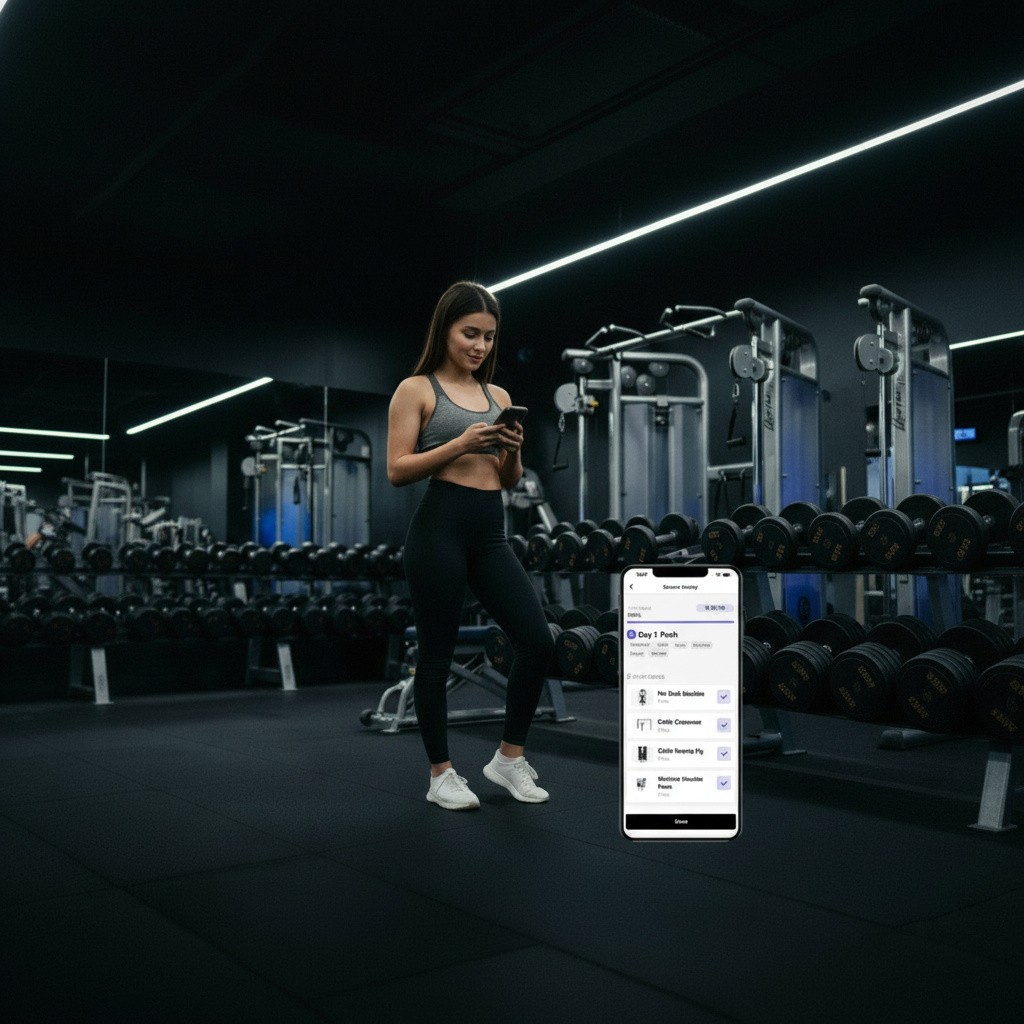
A scheduled multi-week programme. Your goal, days, difficulty, equipment, split and injuries become a dated week of real sessions, each exercise carrying a written reason. You read the whole thing before your first set, and it updates week to week from what you log.
A progression rule you can argue with. Reps first inside the prescribed range, then the smallest weight increment your equipment allows, and the plan only changes around you off a confirmed plateau, two misses rather than one, because one bad set is more often a bad night than a real ceiling.
Fuel. Scan a plate or a barcode, check protein, carbs and fat, no red numbers and no shame. None of the other three includes food, so a stall in any of them reads as a training failure. It is frequently an eating failure.
The scheduler, the AI coach and the body budget. A missed Wednesday is reshuffled into the rest of the week instead of quietly disappearing. The rack is taken, your shoulder hurts, you have 30 minutes instead of 60: one sentence to the AI coach rebuilds the session from the same rules. The body budget keeps one tally across four deposits, your workout, your streak, your sleep and your nutrition.
It also sits alongside Apple rather than against it. Steps and workouts come through our Apple Watch integration rather than being counted twice, which is the point of the ecosystem argument: you are not being asked to leave anything.
Where our claims run thin
No head to head trial exists. Nobody has randomised people to Pocket Fit against Fitness+, Strava or Peloton. Anyone claiming their engine is proven superior to a competitor's is telling you something they cannot know, us included.
The mortality evidence is observational. Momma and colleagues pooled cohort studies, not trials, and rated the certainty of most outcomes as low or very low under GRADE. People who lift twice a week differ from those who do not in ways no adjustment removes. It is a strong reason to strength train, not proof our app makes you live longer.
The J-shape cuts against the train-more instinct too. Maximum risk reduction landed at 30 to 60 minutes a week, with no clear benefit past about an hour. If you already lift three times a week for health reasons, the return on a fourth session is smaller than any marketing implies, ours included.
We are the smallest company here by an enormous margin. Our exercise library is smaller than Peloton's catalogue and our video production is not in Apple's league.
How to stack them without paying for four subscriptions
- Fix your actual bottleneck first. Not knowing what to lift is a programming problem. Knowing exactly what to lift and not going is a motivation problem, and Strava or Peloton is the better spend.
- Assume two, not four. A strength programme plus one cardio or social layer covers almost everybody, which is what the combined-activity finding points at.
- Use the free tiers as a real test. Pocket Fit is free to start with no card, Peloton runs 30 days, Apple gives a month or three with an eligible device, and Strava has a permanent free tier.
- Then protect the week, not the session. Whatever you buy should make a missed Wednesday recoverable.
Put it together
Four products, four jobs. Apple Fitness+ hands you a well-made class and a schedule of classes. Strava hands you the record, the map and the leaderboard. Peloton hands you an instructor and increasingly a plan built around one. Pocket Fit hands you what none of the other three is built to hand you: dated sessions, prescribed sets and reps, reps before weight and weight only off a confirmed plateau, a scheduler that moves a missed session rather than deleting it, an AI coach that rebuilds a session from one sentence, Fuel for the food, and a body budget across workouts, streak, sleep and nutrition.
The founder note, because it explains the design. Georgi built Pocket Fit after going from 122 kg to winning first place at The Yard Games, having lost 38 kg along the way. The app is not shaped by the good weeks. It is shaped by the bad ones, the missed sessions and the plans rebuilt in a car park with the wrong equipment. That is our story, and it is why the scheduler forgives.
Pocket Fit vs Apple Fitness+, Strava and Peloton: common questions
Is Pocket Fit better than Apple Fitness+?
They do different jobs, so neither is better in general. Fitness+ is a library of filmed classes with Custom Plans that schedule activities and durations, at £9.99 a month or £79.99 a year and shareable with five family members, which we cannot beat on household value. Pocket Fit prescribes loads on named lifts, progresses reps before weight, reschedules a missed session and includes food.
Can Strava replace a strength training app?
No, and Strava does not claim it can. Its help centre lists Training Plans specifically for running and cycling, and the rest of the subscription is endurance analytics: segments, Relative Effort, Fitness and Freshness, Grade Adjusted Pace and routes. You can log a gym session there, but nothing programmes or progresses it.
Do I need Peloton hardware to use the Peloton app?
No. App One gives you the class library with no equipment, and App+ adds classes built for any exercise bike, treadmill or rower rather than only Peloton's. If you own a Bike or Tread, App+ is included in your All-Access Membership. There is a 30-day free trial, and prices are worth checking on onepeloton.co.uk because they vary.
Which should I buy if I only want one subscription?
Answer the bottleneck question. If you cannot tell what to lift or when, buy the programme engine. If you know exactly what to do and the problem is turning up, buy the instructors or the social feed, because a session you do beats a perfect plan you ignore.
How much strength training do I actually need?
Less than the marketing suggests. Momma and colleagues found maximum risk reduction, around 10 to 20%, at roughly 30 to 60 minutes of muscle-strengthening activity a week, with the lowest relative risk of 0.83 at about 40 minutes and no clear further benefit past an hour. That is two or three sessions. For muscle growth the dose is measured in sets per week, at roughly 0.37% extra gain per additional weekly set.
References
- Apple. Apple Fitness+ (UK): 12 workout types, sessions of 5 to 45 minutes, Custom Plans including Stay Consistent and Push Further, Apple Watch not required, Family Sharing with up to five members, £9.99 a month or £79.99 a year. Read August 2026. apple.com/uk/apple-fitness-plus
- Strava Help Centre. Strava Subscription Features: segment leaderboards, Live Segments, Relative Effort, Fitness and Freshness, Grade Adjusted Pace, route tools, group challenges, and Training Plans for running and cycling. Accessed August 2026. support.strava.com
- Peloton. Peloton App (UK): App One and App+ tiers, App+ on any exercise bike, treadmill or rower, All-Access Membership inclusion, 30-day free trial, classes of 5 to 90 minutes across 15 or more workout types, and Peloton IQ personalised plans. Read August 2026. onepeloton.co.uk/app
- Momma H, Kawakami R, Honda T, Sawada SS (2022). Muscle-strengthening activities are associated with lower risk and mortality in major non-communicable diseases: a systematic review and meta-analysis of cohort studies. British Journal of Sports Medicine, 56(13), 755-763. DOI: 10.1136/bjsports-2021-105061
- Schoenfeld BJ, Ogborn D, Krieger JW (2017). Dose-response relationship between weekly resistance training volume and increases in muscle mass: A systematic review and meta-analysis. Journal of Sports Sciences, 35(11), 1073-1082. DOI: 10.1080/02640414.2016.1210197
- Apple App Store. Pocket Fit (Pocket Squats) listing, checked August 2026. apps.apple.com/gb/app/pocket-squats/id6748518785
- Pocket Fit pricing, as published on pocket-fit.app/pricing
Pocket Fit is a fitness and wellbeing app, not a medical device. It does not diagnose, treat or prevent any condition. Always consult a qualified healthcare professional before starting or changing a training or nutrition programme, and if you have persistent problems with sleep, pain or fatigue. Georgi, founder of Pocket Fit. He went from 122 kg to winning first place at The Yard Games, having lost 38 kg along the way.
Related articles
Exercise guides from this article
Browse the full exercise library →Train smarter with Pocket Fit
Download the app