Apple Watch workout tracker: your phone costs you the rest, not the set
In a 20-person trial, lifters free to use their phones moved the same weight as lifters limited to music. What the phone changes is the rest in between, and rest under 60 seconds is the one the research says costs you a little muscle.
11 min readUpdated November 2026
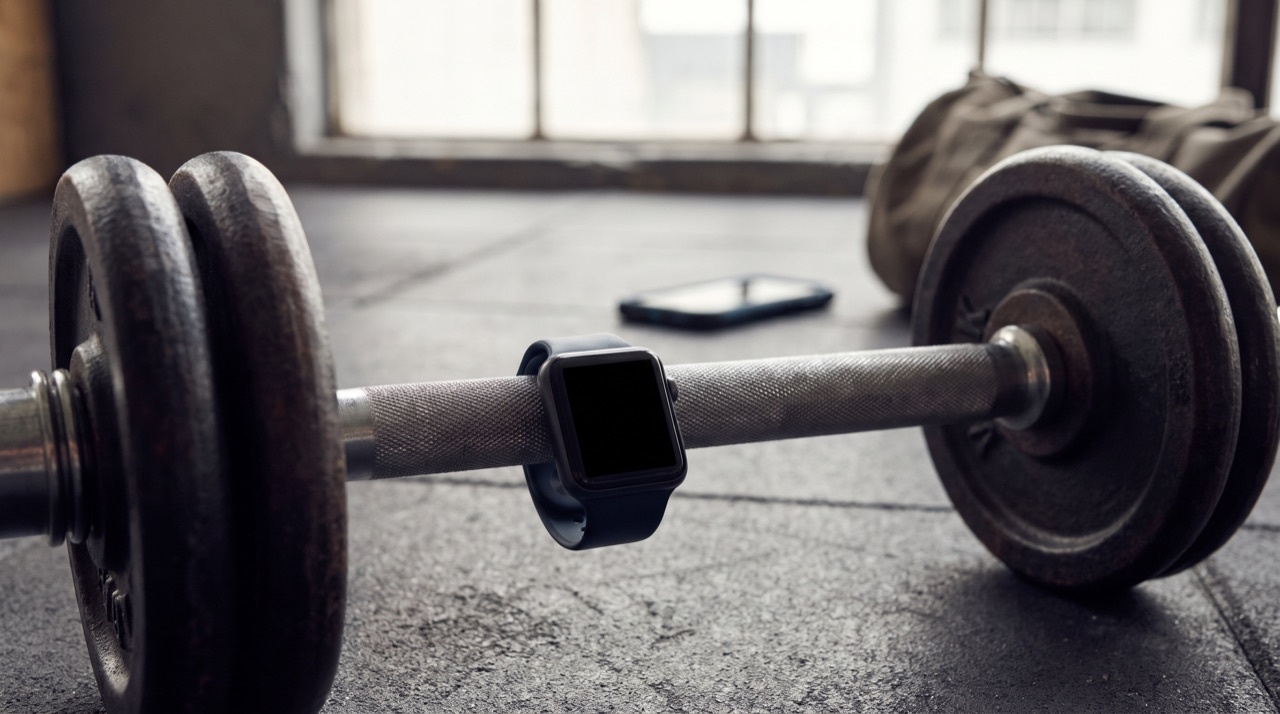
You finish a set of squats, rack the bar and reach for your phone to log it. The app is open, so you glance at a message. Then a video. You look up and the person waiting for the rack is staring at you. You have no idea if you rested forty seconds or four minutes, and the next set feels heavier than it should.
Most people assume the phone is a problem because it makes them lazy, that it quietly takes weight off the bar. That is a reasonable guess, and the research does not really back it. The phone does not seem to touch the set itself. What it touches is the bit nobody tracks: the rest, and the state of your head when the rest ends.
That is a quieter problem, and a fixable one. The fix is less about willpower and more about where the logging lives.
Your phone does not steal the set
Start with the surprise. Rekstis and colleagues ran a small trial for the Pamukkale Journal of Sport Sciences in 2025. Twenty college-age students did two 30-minute resistance sessions. In one they could use their phones for anything. In the other, the phone was for music only.
The weight they moved did not change. Volume-load and intensity were not significantly different between the two conditions, for upper body or lower body. If you were expecting proof that scrolling makes you weaker, this is not it.
What did change was how the session felt. With full phone access, people liked the workout less and felt it was less productive, on both days. Same work done, a worse experience of doing it. That matters more than it sounds. A session you rate as a waste is a session you are less keen to repeat, and repeating it is the whole game.
It steals the head you bring to the next set
The second study looks at a different route. Gantois and colleagues published a randomised, single-blinded crossover trial in Perceptual and Motor Skills in 2021. Sixteen recreationally trained adults did three sets of half back squats to failure at 80% of their 15-rep max. Before one session they spent 30 minutes on social media apps on their phone. Before the other they watched a documentary.
After the social media, they felt more mentally tired, and they lifted less total volume across the three sets. Their perceived effort, motivation and blood lactate were no different. The authors read that as a mental effect, not a physical one. The legs were fine. The head brought less to the bar.
Put the two studies side by side and a pattern appears. A phone in your hand during a session does not obviously take weight off. A stretch of scrolling can leave you mentally flat for the sets that follow. Neither is dramatic. Both point the same way: the phone works on your attention, and your attention is what you lift with when the set gets hard.
Rest under a minute costs a little muscle
Now the rest itself. Singer, Wolf, Schoenfeld and colleagues pooled the trials on rest between sets in a 2024 Bayesian meta-analysis for Frontiers in Sports and Active Living. It covered 9 studies and 19 muscle measurements across the arms, thighs and whole body.
The finding was a small hypertrophy benefit to resting longer than 60 seconds, probably because longer rest lets you keep more weight and reps on the bar across your sets. Past about 90 seconds, they found no appreciable extra gain. So the target is not "rest as long as possible". It is "do not rush it, and do not drift".
One of the trials in that pool shows why short rest bites. Schoenfeld and colleagues put 21 resistance-trained men on 1-minute or 3-minute rest for 8 weeks in the Journal of Strength and Conditioning Research. The 3-minute group gained more strength on the squat and bench press and more muscle thickness on the front of the thigh.
Here is where the phone comes back in. A rest period run off a feed has no shape. Some nights it is thirty seconds because you got bored. Some nights it is five minutes because a video ran on. Neither is what you planned, and the research says the planned number is the one doing the work.
Where the evidence runs thin
Be honest about what these studies can and cannot carry.
- No trial tests the exact thing. Nobody has yet measured phone use only during the rest between sets. Rekstis allowed phones across the whole session. Gantois put the scrolling before the lifting. The link to rest periods is a reasonable inference, not a finding.
- The samples are tiny. Twenty people in one study, sixteen in the other, twenty-one in the rest trial. One session or a few weeks each. Small studies are noisy, and a single null result in 20 students does not prove phones are harmless.
- Mostly young men, mostly untrained. In the Singer meta-analysis, six of the nine studies were men only and six used untrained people. The interventions ran 5 to 10 weeks. Longer studies in trained women might look different.
- The effects are small. The rest-interval benefit is real but modest, and the credible intervals cross zero for individual body parts. This is a tidy-up, not a transformation.
- Conflicts. One senior author on the meta-analysis previously sat on the scientific advisory board of a fitness equipment company. That is disclosed and common in the field, but worth knowing.
So the claim here is modest. Keeping the phone away and the rest steady probably helps a little, and costs you nothing. That is a good trade, not a miracle.
What Pocket Fit's Apple Watch app does between sets
This is the gap Pocket Fit's Apple Watch app is built for. The phone has to come out to log a set, and once it is out, the rest is at the mercy of whatever is on the screen. The watch takes that job.
From your wrist you can see today's scheduled workouts and your programmes, and start a session straight from the watch. The phone starts it, and the watch then mirrors it: the exercise list, and each set's target reps and weight, in kg or lbs to match your setting. Log the reps and weight you actually did, and it syncs to the phone instantly.
Logging a set starts the rest timer automatically, using the rest time set for that exercise, or 60 seconds if none is set. The rest screen keeps it simple. A progress bar with the countdown sits at the top. In the centre is "Up next": the next exercise, its target reps and weight, and which set it is, such as "Set 2 of 4". There are small +15s and Skip buttons, and you can tuck the timer away. It stays in sync with the timer on your phone. When you are done, finish from the watch and the phone opens your workout review.
A few practical moves from the research:
- Leave the phone in your bag. Log from the wrist and you remove the main reason to pick it up between sets.
- On heavy compound lifts, tap +15s rather than cutting it short. The evidence leans towards more than 60 seconds, with little extra gained past about 90.
- Read "Up next" during the rest. Knowing the next weight and rep target is a better use of the minute than a feed.
- Use Skip only when you mean it, such as on light accessory work, not because the timer felt long.
A note on what it is not. The watch app is a companion to the iPhone app, not a standalone one, so you need your iPhone with you. It is about running your session, not tracking heart rate or GPS.
Put the phone away, keep the rest honest
Put it together. The phone probably does not take weight off the bar during a set. It does make the session feel worse, it can leave your head flat for the sets that follow, and it turns a planned rest into whatever the feed decides. Rest under a minute costs a little muscle, and rest that drifts just stretches the session without adding anything. The fix is to log where the phone is not.
Every logged set still feeds the rest of Pocket Fit. Your workout is one of the four deposits in your Body budget, alongside your streak, your sleep and your nutrition. The programme updates week to week from what you log, which is why adding reps before adding weight only works if the reps are recorded honestly. If a session gets missed, the scheduler moves it into the rest of your week. If you need to change one, the AI coach rebuilds it from a sentence. And on the weeks when sleep is short, the session still counts if you go a bit lighter.
Pocket Fit exists because of the bad weeks, and plenty of bad weeks are made of small leaks like this one rather than one big failure. Going from 122 kg to first place at The Yard Games, 38 kg lighter, was mostly about showing up and doing ordinary sets properly, one after another. You can read how that started here.
Apple Watch workout tracker: common questions
Does Pocket Fit have an Apple Watch app?
Yes. Pocket Fit's Apple Watch app shows today's scheduled workouts and your programmes, and lets you start a session from your wrist. During the workout it mirrors the phone, so you can see each set's target reps and weight and log what you did. Each set syncs to your phone instantly.
Can I use the Pocket Fit watch app without my iPhone?
No. It is a companion app, so it needs the Pocket Fit iPhone app. When you start a workout from the watch, the phone starts the session and the watch mirrors it. Keep the phone nearby in your bag or pocket, you just do not need to hold it.
How long should I rest between sets for muscle growth?
A 2024 meta-analysis of 9 studies found a small benefit to resting longer than 60 seconds, with no appreciable extra gain past about 90 seconds. In one 8-week trial in trained men, 3-minute rest beat 1-minute rest for squat and bench strength. On heavy lifts, a little over a minute is a sensible floor.
Does using my phone at the gym make me weaker?
Probably not during the set itself. In a 20-person trial, free phone use did not change volume-load or intensity compared with music only, though people enjoyed the session less. In a 16-person trial, 30 minutes of social media before squats raised mental fatigue and lowered total volume, so long scrolling stretches seem to be the bigger risk.
Does the watch show kg or lbs, and does it work on Wear OS?
It shows weights in kg or lbs to match your setting in the app. The watch app is for Apple Watch only. Pocket Fit itself is on Android through Google Play, but there is no Wear OS version of the watch app.
References
- Rekstis M, Beach E, Cornell T, Kobak M, Rebold M (2025). The effects of smartphone use during resistance training. Pamukkale Journal of Sport Sciences, 16(1), 154-168. DOI: 10.54141/psbd.1588327
- Gantois P, de Lima-Júnior D, Fortes LS, Batista GR, Nakamura FY, Fonseca FS (2021). Mental fatigue from smartphone use reduces volume-load in resistance training: a randomized, single-blinded cross-over study. Perceptual and Motor Skills, 128(4), 1640-1659. DOI: 10.1177/00315125211016233
- Singer A, Wolf M, Generoso L, et al., Schoenfeld BJ (2024). Give it a rest: a systematic review with Bayesian meta-analysis on the effect of inter-set rest interval duration on muscle hypertrophy. Frontiers in Sports and Active Living, 6, 1429789. DOI: 10.3389/fspor.2024.1429789
- Schoenfeld BJ, Pope ZK, Benik FM, et al. (2016). Longer interset rest periods enhance muscle strength and hypertrophy in resistance-trained men. Journal of Strength and Conditioning Research, 30(7), 1805-1812. DOI: 10.1519/JSC.0000000000001272
Pocket Fit is a fitness and wellbeing app, not a medical device. It does not diagnose, treat or prevent any condition. Always consult a qualified healthcare professional before starting or changing a training or nutrition programme, and if you have persistent problems with sleep, pain or fatigue. Georgi, founder of Pocket Fit. He went from 122 kg to winning first place at The Yard Games, having lost 38 kg along the way.
Related articles
Exercise guides from this article
Browse the full exercise library →Train smarter with Pocket Fit
Download the app