Training on poor sleep: what to change and what to keep
Training on poor sleep costs you most in the afternoon and least in the morning, and the injury warning you have read rests almost entirely on studies of teenagers.
8 min readUpdated March 2026
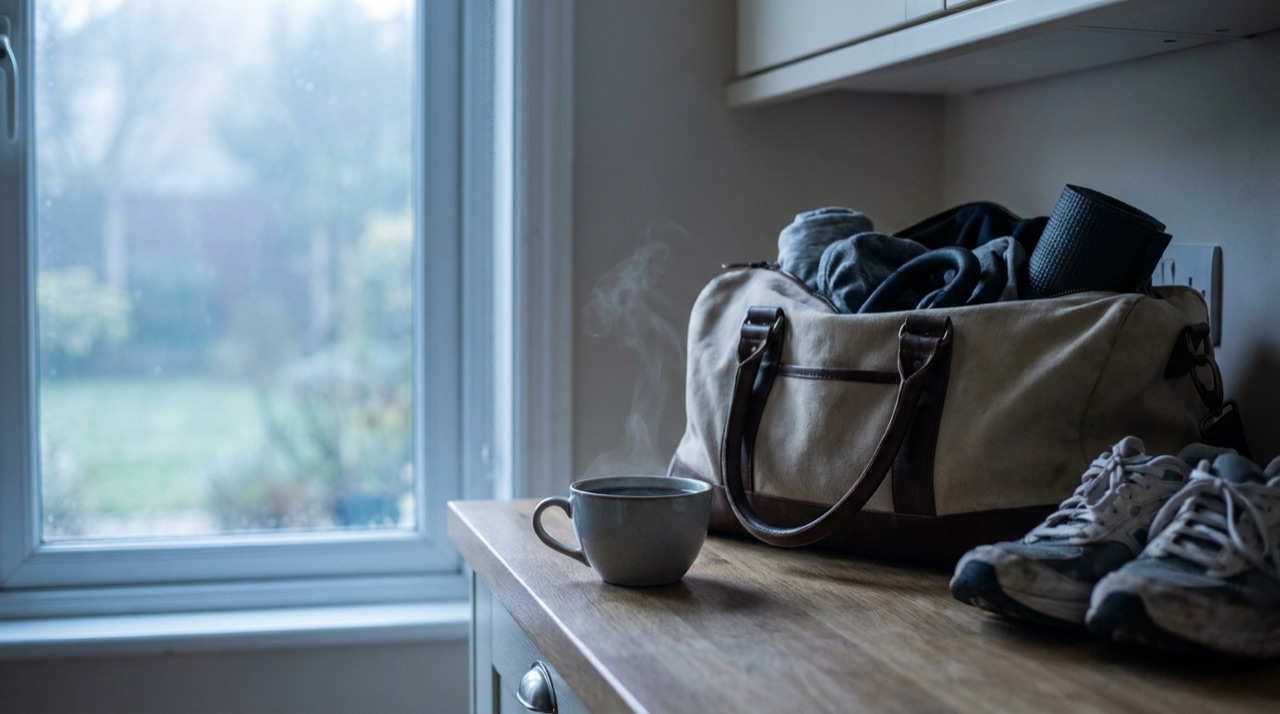
Six hours became four. So you are in the kitchen at half past six with a coffee you did not want. And you are running the calculation everyone runs about training on poor sleep. Go in and have a bad one. Or stay home and lose the session.
Both options assume today is already decided. It is not.
What the research shows is that the cost of a bad night is not a fixed penalty. It moves, and it moves according to things you control, starting with the hour you walk through the door.
Move the session to the morning
Craven and colleagues pooled 227 outcome measures from 69 studies for Sports Medicine. Across everything they measured, sleep loss cut exercise performance by an average of 7.56%.
Then they split the results by time of day, and the split is the useful part. Sessions performed in the afternoon and evening were consistently worse. Sessions performed in the morning were largely unaffected.
They also found a straight line between how long you had been awake and how badly the session went: roughly 0.4% worse for every hour awake beforehand.
So a bad night does not hand you a fixed bill. It starts a meter, and the meter runs all day. Walk in at seven in the morning and you have been up for an hour. Walk in at seven in the evening and you have been up for thirteen. That is the gap between a session that mostly holds and one that does not.
So the first decision about training on poor sleep is not whether. It is when.
The authors put it in their own conclusion. When sleep loss is coming and cannot be helped, train in the morning.
A late night is not the same as an early alarm
Craven's team also split the studies by how the sleep was lost, and almost nobody reports what they found.
Consistent negative effects turned up in only two conditions. One was total deprivation, meaning a night with no sleep. The other was late restriction, meaning something woke you earlier than normal.
Early restriction, meaning you went to bed later than usual and then slept through, did not produce a consistent effect on performance.
Same hours lost. Different damage.
That distinction is worth carrying around. A one o'clock finish that still lets you wake naturally is a different event from a five o'clock alarm after a normal bedtime. The evidence treats them differently because they behave differently.
The injury warning is weaker than you have been told
Nearly every article on this subject warns you about injury, and nearly all of them trace back to a single number. Athletes sleeping under eight hours a night were 1.7 times more likely to have been injured.
Look at where that number comes from. Milewski and colleagues surveyed 112 adolescent athletes, mean age 15, at a middle and high school. Injuries were self-reported through a survey. And the confidence interval ran from 1.0 to 3.0. Its lower bound sits exactly on no effect at all.
That is a real finding about teenagers. It is a much weaker finding about you.
Dobrosielski and colleagues went looking for the adult version and published a systematic review in Sports Medicine. Their conclusion is one the category never repeats. The current evidence does not support poor sleep as an independent risk factor for sport or training-related injury in adult athletic populations. They were equally clear that the studies were too varied to settle the question, and that better prospective research is needed.
So the position is unproven, in both directions. Not safe. Not the emergency you have been sold either.
What to change when training on poor sleep
Keep the session. Move it earlier. Then lower what you ask of it.
- Train in the morning if the day allows it. This is the single best-supported practical move in this article, and it costs nothing.
- Expect a worse session and plan around it. The pooled average is roughly 7% down. That makes today a poor day to chase a personal best and a fine day to do the work you had planned.
- Judge the day on attendance, not on the numbers. A session that is 7% down still happened, and the ones that happen are the only ones that add up.
- If something genuinely hurts, that is a different conversation. Tiredness is not pain, and pain is not something to train through.
Where this evidence runs thin
Craven's review reported very high heterogeneity. That is a statistician's way of saying the studies disagreed with each other a lot. So treat the 7.56% average as a direction rather than a forecast.
The participants were 89% male. Almost none of this work has been done properly in women, and that is true across nearly the whole sleep and training literature.
The early-restriction finding rests on fewer studies than the rest. No consistent effect is not the same as no effect. It means nobody has shown one yet.
And every number here comes from short-term laboratory sleep loss. None of it followed anybody through an ordinary bad year.
Tired is a number, not a character flaw
You did not fail that session. You did it at six in the evening, after nineteen hours awake, on a night that took roughly seven percent off the top. Then you read the result as evidence about who you are.
That is the move worth stopping. Tired is a number, and training on poor sleep is a scheduling problem before it is anything else. The number moves with the hour you train and the hours you have been up. Both are things you can change tomorrow.
Pocket Fit is built to change the session rather than cancel it. Tell the AI coach that today is a write-off and it rebuilds the session in a sentence. Swap an exercise, cut the volume, or rewrite the whole thing. Miss it anyway and the scheduler moves it into the rest of the week rather than deleting it. And the programme updates week to week from what you logged, so a rough week teaches it something.
I spent years not knowing what to do on a gym floor. The hard question was never whether to turn up. It was what to do once I had. That question is the reason this app exists, and you can read how it started here.
Training on poor sleep: common questions
Should I train after a bad night?
Usually yes. The pooled evidence puts the average cost of training on poor sleep at around 7%. That is a worse session rather than a wasted one. Move it to the morning if you can, drop any personal-best plans, and do the work you had scheduled.
Is morning training really better after poor sleep?
Morning sessions came out largely unaffected in a review of 227 outcomes. Afternoon and evening sessions were consistently worse. Performance fell by roughly 0.4% for every hour spent awake beforehand, so the earlier the session, the smaller the cost.
Does poor sleep raise my injury risk?
The evidence is thinner than you have been told. A systematic review of adult athletes found that current evidence does not support poor sleep as an independent injury risk factor. Its authors called for better research. The widely quoted 1.7 times figure comes from a survey of 112 adolescent athletes, mean age 15.
Which is worse, a late night or an early alarm?
An early alarm, on the current evidence. Reviewers found consistent performance drops after total sleep loss and after being woken earlier than normal. Going to bed later than usual and sleeping through did not show a consistent effect, though fewer studies have tested it.
Can Pocket Fit adjust my session when I am tired?
Yes. Tell the AI coach how the week went and Pocket Fit rebuilds the session, swapping exercises, cutting volume or rewriting the plan. Your programme also updates week to week from what you log, and the scheduler moves a missed session rather than dropping it.
References
- Craven J, McCartney D, Desbrow B, Sabapathy S, Bellinger P, Roberts L, Irwin C (2022). Effects of acute sleep loss on physical performance: a systematic and meta-analytical review. Sports Medicine, 52(11), 2669-2690. DOI: 10.1007/s40279-022-01706-y
- Dobrosielski DA, Sweeney L, Lisman PJ (2021). The association between poor sleep and the incidence of sport and physical training-related injuries in adult athletic populations: a systematic review. Sports Medicine, 51(4), 777-793. DOI: 10.1007/s40279-020-01416-3
- Milewski MD, Skaggs DL, Bishop GA, Pace JL, Ibrahim DA, Wren TAL, Barzdukas A (2014). Chronic lack of sleep is associated with increased sports injuries in adolescent athletes. Journal of Pediatric Orthopaedics, 34(2), 129-133. DOI: 10.1097/BPO.0000000000000151
Pocket Fit is a fitness and wellbeing app, not a medical device. It does not diagnose, treat or prevent any condition. Always consult a qualified healthcare professional before starting or changing a training or nutrition programme, and if you have persistent problems with sleep, pain or fatigue. Georgi, founder of Pocket Fit. He went from 122 kg to winning first place at The Yard Games, having lost 38 kg along the way.
Related articles
Free tools
Train smarter with Pocket Fit
Download the app