Progressive Overload Runs on Protein: Why the Bar Stops Climbing When You Under-Eat
The plateau that will not break is usually a fuelling problem, not a programming one. Under-eat, especially under-protein, and the reps stop climbing, so the bar never earns its next jump.
11 min readUpdated March 2026
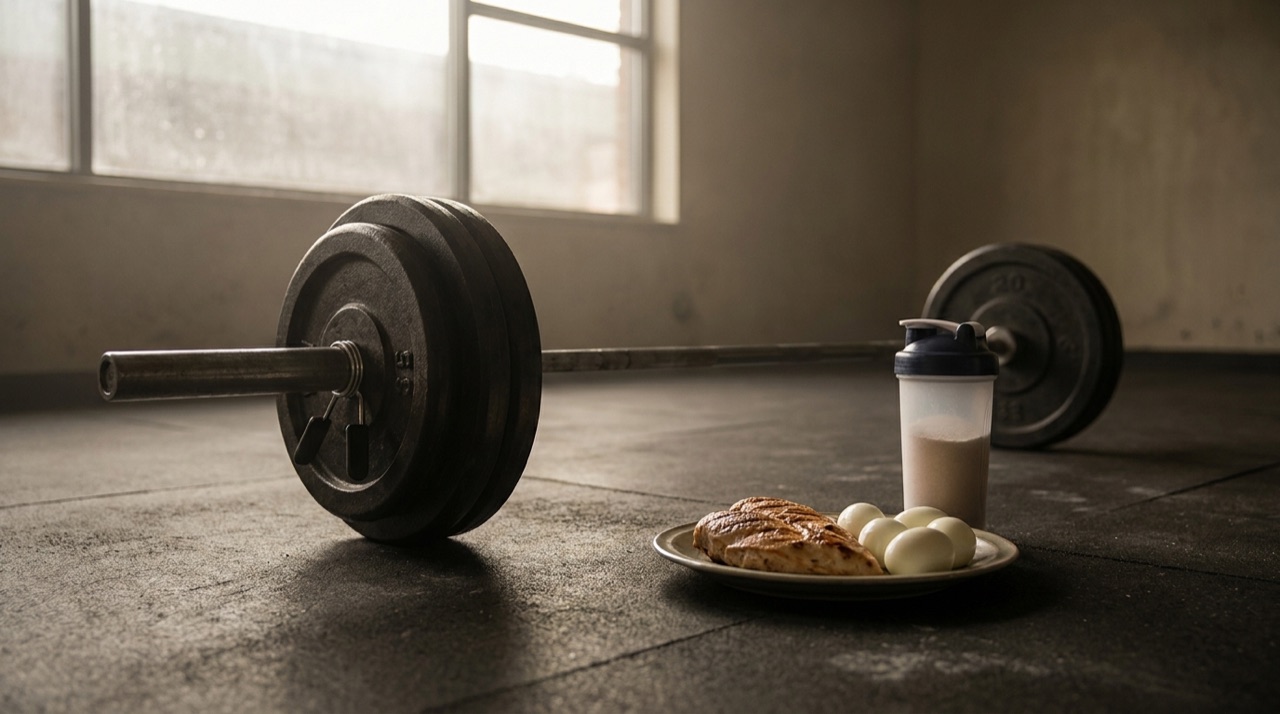
You have been running the same programme for weeks. The plan is sound, the effort is there, and yet the bar has not moved. Last month you were adding reps almost every session. Now the same weight that felt manageable grinds to a halt at rep eight, and the tenth rep you used to own has quietly disappeared. So you do the obvious thing. You question the programme. You add a set, swap an exercise, chase a new split, maybe buy a fancier plan.
Here is the assumption that traps most people. When the weight stops climbing, they treat it as a training problem and go looking for a better programme. Most of the time it is not a training problem at all. It is a fuelling problem wearing a training problem's clothes. You cannot add to the bar until your reps climb, and you cannot keep hitting those reps if you are under-fed and under-recovered. Protein for muscle growth is not a supplement-shelf nicety. It is the thing that lets progressive overload happen in the first place.
How progression actually gets earned
Progressive overload does not mean adding weight on a schedule. It means the demand on your muscles has to keep rising, and the cleanest way to raise it is to do more work with the load already in front of you. Pocket Fit's progression engine follows that order exactly, and it is worth understanding because it explains why fuelling matters so much.
Reps come first. When you finish a set, the engine looks at your history and, if you are ready, nudges the target up by one rep at a time, never more, and never past a cap of fifteen. Only once you have held the same weight across two sessions in a row, a confirmed plateau rather than a single hard day, does the weight itself move. And it moves in small, equipment-specific steps: a barbell goes up 5 kg for men and 2.5 kg for women, while dumbbells, cables and everything else move in 2.5 kg or 1.25 kg steps by sex. If your reps drop instead of climb, the engine suggests nothing and waits.
Read that back and the dependency becomes obvious. The whole system is driven by one thing you control on the gym floor: your ability to add a rep. Add reps, and eventually the bar earns its jump. Stop adding reps, and the engine has nothing to act on. The bar sits still not because the rule failed, but because you stopped feeding it the signal. And the single most common reason the reps stop climbing has nothing to do with your programme.
Why protein protects the reps and the muscle
Muscle is built from protein and it is broken down and rebuilt constantly. Training tips that balance towards building, but only if the raw material is there. When you chase eating for progressive overload without enough protein, you ask the body to remodel a wall while withholding the bricks.
The evidence for how much this matters is unusually clean. Robert Morton and colleagues pooled 49 randomised trials with 1,863 participants for the British Journal of Sports Medicine and found that adding protein to a resistance-training programme produced meaningful extra gains in strength and fat-free mass beyond training alone. The interesting number was the ceiling. Benefit kept rising with intake up to roughly 1.6 g of protein per kilogram of bodyweight per day, and past that point the meta-regression could no longer detect an advantage. In plain terms: below that threshold you are leaving reps on the table, and above it you are not buying much more.
This is the mechanism behind the stalled bar. Under-fed muscle recovers slower and less completely between sessions. The set that should have given you a ninth rep gives you eight, the plateau never resolves upward, and the engine never gets its cue to add weight. Fix the protein and the reps often start creeping back on their own, which is exactly the signal the progression rule is waiting for. If you want the mechanics of that reps-first rule in full, we walk through it in reps first, then weight.
How much protein to build muscle
The honest answer to how much protein to build muscle is a range, not a magic number, and it is a process target rather than a promise. Nobody can tell you that eating a precise amount will add a precise amount of muscle by a precise date. What the evidence supports is a floor to clear and a band to aim for.
- Around 1.6 g per kg of bodyweight per day is the intake at which Morton's meta-analysis stopped detecting extra benefit for muscle and strength. Treat it as a sensible target, not a hard cap.
- A practical band of roughly 1.6 to 2.2 g per kg covers most lifters and gives you room on higher-training days without obsessing over decimals.
- When you are dieting, aim towards the upper end. In a deficit, protein does double duty, and skimping is where lifters quietly lose the muscle they trained for.
- Spread it across the day rather than stacking it all at dinner. Three or four protein-forward meals is easier to hit and easier to digest than one enormous one.
None of this requires weighing every gram. It requires knowing, roughly, whether you cleared the floor today. That is a much smaller ask than most people think, and it is the one Pocket Fit's Fuel tool is built to answer.
Training in a calorie deficit and strength
Now the part most articles get wrong in one direction or the other. Some tell you that you cannot build muscle while losing fat, which is too pessimistic. Others promise easy "recomp" for everyone, which is too generous. The truth sits in between, and it is genuinely encouraging if you keep protein high.
Thomas Longland and colleagues put 40 young men through a brutal four-week programme for the American Journal of Clinical Nutrition: a 40 percent calorie deficit, six days of hard training a week, and either 1.2 or 2.4 g of protein per kilogram. Both groups lost fat. But the higher-protein group gained 1.2 kg of lean mass while losing 4.8 kg of fat, and the lower-protein group merely held its lean mass while losing 3.5 kg. Same deficit, same training, radically different body composition, decided almost entirely by protein.
The message for the calorie deficit and strength question is measured. In a deficit you can often still progress, especially if you are newer or carrying some fat to lose, but progress is slower and less certain than in a surplus. Recovery is tighter, so some sessions the reps will not climb, and that is not failure. What you are really buying with high protein in a deficit is protection: you keep the muscle and the strength you already earned instead of dieting it away. For how that plays out session to session, see calorie deficit and strength training.
Where the evidence runs thin
The case for protein is strong, but honesty means naming its edges. Morton's threshold of 1.6 g per kg is a population average with a wide confidence interval, and the trials leaned towards younger, mostly male, resistance-training participants. Your own number could sit higher, and older lifters in particular may need more to get the same effect.
Longland's study is striking, but it was four weeks long, in young trained men, under laboratory-tight conditions, with protein intakes that are hard to sustain in normal life. Short trials cannot tell you what a year looks like. Helms and colleagues, reviewing dietary protein for lean athletes in a deficit for the International Journal of Sport Nutrition and Exercise Metabolism, argued that very lean, heavily dieting athletes may need intakes towards the top of the range, scaled to leanness. That is a caveat, not a universal prescription, and most people reading this are not contest-lean.
And protein is necessary, not sufficient. Total calories, sleep, training quality and consistency all sit alongside it. Eat plenty of protein but sleep four hours and under-recover, and the reps still will not climb; our piece on sleep and fat loss covers that side. Protein removes one of the most common brakes on progress. It does not remove all of them.
Where Pocket Fit fits
Everything above comes down to a single loop: eat enough protein, keep earning reps, let the bar climb. The hard part is not knowing the loop. It is knowing, on any given ordinary Tuesday, whether you actually cleared your protein floor and whether the stall in your log is fuelling or programming. That is the gap Pocket Fit is built to close.
Fuel is the nutrition side. Scan a plate or a barcode and it shows your protein, carbs and fat against your target, with no red numbers and no shame, just a clear read on whether you hit the floor today. On the training side, the progression engine watches your logged reps and only adds to the bar off a confirmed two-session plateau, so a stalled bar becomes a diagnostic rather than a mystery. Reps climbing but the bar not moving yet means the system is working. Reps not climbing at all points you straight back at the plate. If you want to log meals in seconds, logging food with a photo shows how.
Both feed the Body budget: a running tally of four deposits, your workout, your streak, your sleep and your nutrition, so progress is one honest picture rather than four apps you have to reconcile yourself. The programme updates week to week from what you log, so as your reps and your eating change, the plan changes with them. Pocket Fit exists because the founder lived the bad weeks. Georgi went from 122 kg to winning first place at The Yard Games, losing 38 kg along the way, and learned first-hand that the plate decides whether the training sticks. You can read that in our story.
Protein and progressive overload: common questions
How much protein do I need to build muscle?
Aim for roughly 1.6 to 2.2 g per kilogram of bodyweight per day. Morton's meta-analysis of 49 trials found benefit for muscle and strength rising up to about 1.6 g per kg and no clear extra gain above it, so treat that as your floor rather than a ceiling and lean towards the upper band when you are dieting.
Can I get stronger in a calorie deficit?
Often yes, just more slowly and less reliably than in a surplus. Longland's trial had men gain 1.2 kg of lean mass in a 40 percent deficit on high protein, so progress is possible, but the main thing high protein buys in a deficit is keeping the muscle and strength you already have.
Why has my bar stopped moving even though my programme is fine?
Because the bar only moves after your reps climb and hold for two sessions. If you are under-fed or under-protein, recovery lags, the reps stall, and the progression rule never gets the signal to add weight. The stall is often on your plate, not in your plan.
Is more protein always better?
No. Morton's data could not detect extra muscle or strength benefit beyond about 1.6 g per kg per day for most trained people. Very lean athletes deep in a diet may need more, per Helms and colleagues, but for most lifters, piling on protein past the range mainly displaces other food rather than adding muscle.
Does protein matter more for muscle growth or fat loss?
It matters for both, and most in a deficit. When you are eating for progressive overload in a surplus, adequate protein lets you keep earning reps. When you are cutting, higher protein is what preserves lean mass while the fat comes off, which is exactly what Longland's higher-protein group demonstrated.
References
- Morton RW, Murphy KT, McKellar SR, et al. (2018). A systematic review, meta-analysis and meta-regression of the effect of protein supplementation on resistance training-induced gains in muscle mass and strength in healthy adults. British Journal of Sports Medicine, 52(6), 376-384. DOI: 10.1136/bjsports-2017-097608
- Longland TM, Oikawa SY, Mitchell CJ, Devries MC, Phillips SM (2016). Higher compared with lower dietary protein during an energy deficit combined with intense exercise promotes greater lean mass gain and fat mass loss: a randomized trial. American Journal of Clinical Nutrition, 103(3), 738-746. DOI: 10.3945/ajcn.115.119339
- Helms ER, Zinn C, Rowlands DS, Brown SR (2014). A systematic review of dietary protein during caloric restriction in resistance trained lean athletes: a case for higher intakes. International Journal of Sport Nutrition and Exercise Metabolism, 24(2), 127-138. DOI: 10.1123/ijsnem.2013-0054
Pocket Fit is a fitness and wellbeing app, not a medical device. It does not diagnose, treat or prevent any condition. Always consult a qualified healthcare professional before starting or changing a training or nutrition programme, and if you have persistent problems with sleep, pain or fatigue. Georgi, founder of Pocket Fit. He went from 122 kg to winning first place at The Yard Games, having lost 38 kg along the way.
Related articles
Free tools
Train smarter with Pocket Fit
Download the app