The muscle you lose on a GLP-1 is the weight you did not want to lose
A GLP-1 produces real, large weight loss. But a big slice of what comes off is muscle, not fat, and that is the part you have to fight to keep.
14 min readUpdated March 2026
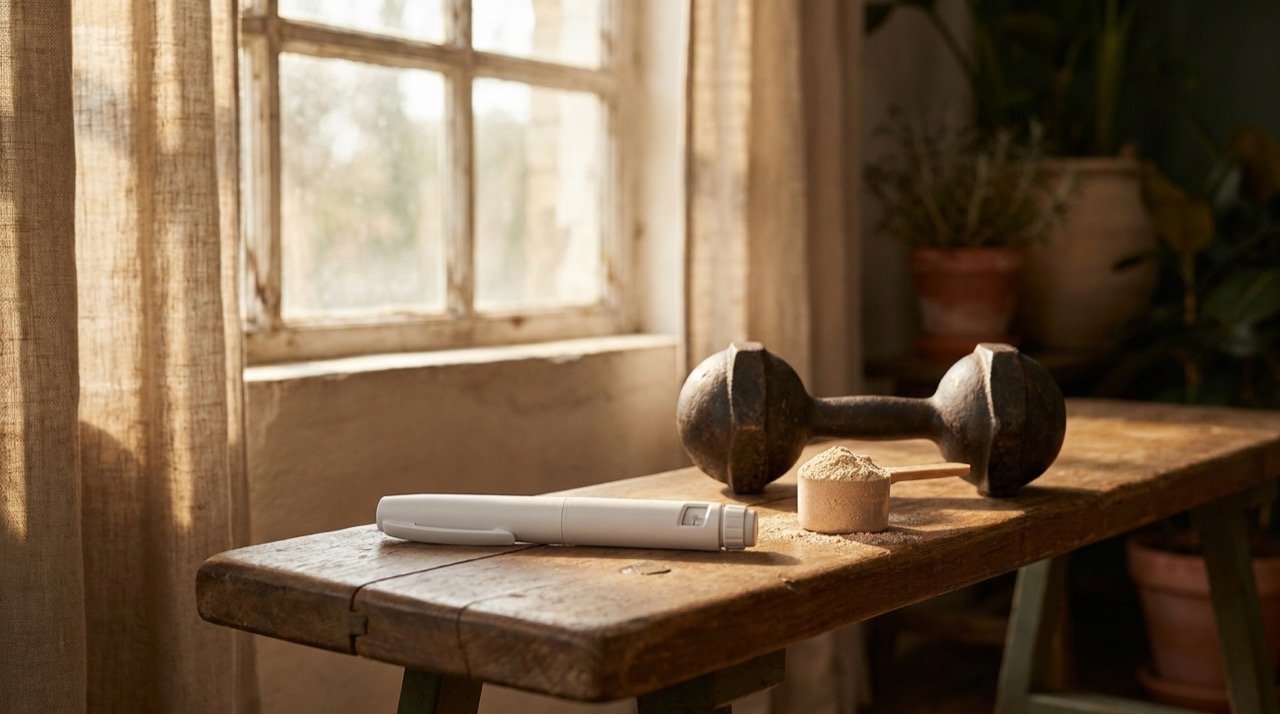
The scale is moving faster than it ever has. Two stone gone, then three, clothes loose, the constant food noise finally quiet. A GLP-1 medication is doing exactly what it promised, and for the first time in years the weight is coming off without a daily battle. So it feels strange to say there is a catch buried inside good news this large. There is one, and it is worth understanding before the weight is gone rather than after.
The assumption almost everyone makes is that weight loss is fat loss. Lose 15 kilos and you picture 15 kilos of fat leaving your body. That is not what the body-composition data shows. A meaningful share of the weight lost on a GLP-1, in some trials close to 40 percent, is lean mass: muscle, connective tissue, the machinery that holds your metabolism up and keeps you strong. The drug shrinks you. It does not automatically shape you.
This is not an argument against the medication. GLP-1 drugs are a legitimate, effective tool, and the decision to take one belongs between you and your doctor, not a fitness blog. This piece is education, not medical advice. What it is arguing is narrower and more useful: while the drug quietly handles your appetite, something has to protect your muscle, because the drug will not do it for you. That something is training and protein. Get those right and the weight you lose is mostly the weight you wanted to lose.
Weight loss and fat loss are not the same thing
Start with the number that surprises people. In the STEP 1 trial, the study that put semaglutide on the map, adults with obesity lost an average of 15.3 kg over 68 weeks against 2.6 kg on placebo. That is a large, real, life-changing amount of weight, and the trial was big and rigorous: 1,961 participants, randomised, double-blind.
The interesting part is what a smaller sub-group of that trial found when researchers scanned bodies rather than just weighing them. In an exploratory analysis using DXA, the gold-standard body scan, 140 participants were measured at the start and again at week 68. Total fat mass fell by 19.3 percent. Total lean body mass fell by 9.7 percent. So fat did make up the larger share of the loss, which is genuinely good. But lean mass still fell by nearly a tenth. Work through the kilograms and lean tissue accounts for roughly 40 percent of everything that came off.
Read that carefully, because the framing matters. It is not that the drug attacks muscle. It is that rapid weight loss of any kind takes some muscle with the fat, and a GLP-1 produces rapid weight loss while also flattening your appetite, which quietly makes it harder to eat the protein that defends muscle. The scale celebrates. It cannot tell you that two out of every five kilos leaving were the wrong two.
The tirzepatide picture is better, and still not zero
It would be dishonest to imply every GLP-1 lands in the same place. The newer dual GLP-1 and GIP molecule, tirzepatide, looks a little kinder to muscle in the data we have. In a body-composition sub-study of the SURMOUNT-1 trial, published in Diabetes, Obesity and Metabolism in 2025, 160 participants were scanned by DXA at baseline and week 72. Body weight fell by 21.3 percent, fat mass by 33.9 percent, and lean mass by 10.9 percent.
Put in proportion, roughly 75 percent of the weight lost was fat and about 25 percent was lean, and the authors noted that ratio held across age, sex, and how much weight people lost. A quarter of the loss being lean mass is a better result than the older semaglutide numbers, and the trial framed it as a favourable body-composition profile compared with diet alone.
But notice what "better" means here. A quarter of a very large weight loss is still a substantial amount of muscle. Neither molecule preserves lean mass on its own. The honest summary across the class is that GLP-1 drugs reliably strip fat, reliably strip some muscle too, and leave the muscle question open for you to answer with what you do outside the pharmacy.
Where the evidence is still thin
This is the part most articles skip, so let me be straight about what these numbers can and cannot tell you.
First, the body-composition findings come from sub-studies, not the headline trials. The STEP 1 scan analysis was 140 people out of nearly 2,000, and it was reported first as a conference abstract. Sub-groups are smaller and noisier than the trials they sit inside, and DXA cannot perfectly separate muscle from water and other lean tissue. Treat the exact percentages as strong estimates, not laboratory constants.
Second, "lean body mass" is not all muscle. It includes organ tissue, connective tissue and body water, some of which naturally falls as you get lighter and is not a loss worth mourning. So the muscle loss is real but the precise figure for skeletal muscle specifically is fuzzier than a single percentage suggests.
Third, and most important, almost none of the drug trials had participants following a structured resistance-training and high-protein plan. They largely captured what happens on the medication with ordinary lifestyle advice. That is exactly the gap this article is about. The lean-mass loss you read in the trials is closer to a worst case for an untrained person than a fixed destiny. What follows is the evidence that the gap can be closed.
Why the lost muscle matters more than the mirror
If the muscle came back on its own, none of this would be worth an article. The concern is that in your 30s, 40s and beyond, muscle is hard to rebuild and quietly expensive to lose.
Muscle is metabolically active tissue: it is a large part of what your body burns at rest, so losing it lowers the floor of your metabolism and makes weight easier to regain if the medication is ever stopped. It is also the tissue behind strength, balance, and the everyday ability to carry, climb and get up off the floor. A review in Advances in Nutrition by Cava and colleagues laid this out plainly: weight loss reliably reduces lean mass, and the health benefits of getting lighter are partly undone if muscle and physical function go with it. Their conclusion was not "avoid weight loss" but "protect muscle while you do it", specifically with adequate protein and resistance-type exercise.
The concern sharpens with age. A systematic review in Nutrition Reviews by Weinheimer and colleagues looked specifically at middle-aged and older adults and found that energy restriction alone tends to cost fat-free mass, while adding exercise, resistance training in particular, protected it. The underlying worry has a name, sarcopenic obesity: carrying excess fat and too little muscle at once, a combination that is worse for strength and metabolic health than either alone. Rapid pharmacological weight loss without training is, in principle, a fast route toward that state for someone who is already losing muscle to age. This is the more speculative end of the evidence, so hold it as a well-grounded concern rather than a proven clinical outcome. But it is the reason the muscle question is not vanity.
The countermeasure is training and protein, and it is well evidenced
Here is the good news that balances the warning: the tools that preserve muscle during weight loss are boring, cheap, and unusually well supported. Two of them, working together.
The first is resistance training. The Weinheimer review is one strand; the broader picture across weight-loss studies is consistent that lifting weights during a deficit is the single most reliable way to hold onto lean mass. You are not trying to build a bodybuilder's physique while eating less. You are sending your body a repeated signal that this muscle is in use and must not be broken down for fuel.
The second is protein, and the evidence here is striking. In a randomised trial by Longland and colleagues in the American Journal of Clinical Nutrition, young men ate in a steep 40 percent calorie deficit for four weeks while training hard. One group ate lower protein, around 1.2 grams per kilogram of body weight; the other ate higher, around 2.4 grams. The higher-protein group gained lean mass and lost more fat, in a deficit, which should not happen if you believe weight loss is simply weight loss. The lower-protein group merely held their muscle. Same deficit, same training, different protein, and the body composition diverged sharply.
Two caveats keep that honest. Longland's subjects were young men training at high intensity, not a 55-year-old three months into a GLP-1, so the exact scale of the effect will not transfer one-for-one. And appetite suppression is precisely what makes hitting a protein target hard on these drugs; the theory is easy and the plate is the hard part. But the direction is not in serious doubt. Train against resistance and eat enough protein, and you steer far more of the loss toward fat.
For someone on a GLP-1 the practical version is short:
- Lift two to three times a week, working the major muscle groups against a load that is genuinely challenging for the last few reps.
- Prioritise protein at every meal, aiming toward the higher end of the general range for people losing weight, because appetite loss will push you low by default.
- Add progressive overload deliberately, nudging reps or weight up over time rather than repeating the same easy session, since more reps at a manageable weight is the safer first lever.
- Do not chase the scale down faster. The medication is already producing a large loss; your job is to change what that loss is made of, not to accelerate it.
None of this treats, replaces or interacts with your medication, and none of it is a reason to change your prescription. It is the layer the drug does not provide.
Put it together: the drug handles appetite, the training decides your body
Here is the whole argument in one pass. A GLP-1 is very good at one job, taking away the appetite that made weight loss feel impossible, and it does that job well enough to produce losses most diets never reach. What it does not do is decide whether the weight leaving is fat or muscle. On the medication alone the answer, in the trials, is that a large minority of it is muscle. With resistance training and enough protein, the answer shifts toward fat, which is the loss you actually wanted.
That division of labour is exactly what Pocket Fit is built around. Tell it your equipment and your days and the programme generator builds an appropriate resistance plan rather than leaving you to guess, then handles progressive overload deterministically so the muscle-protecting signal actually gets stronger week to week instead of stalling. On the food side, Fuel lets you scan a plate or a barcode and tracks protein against a target with no red numbers and no shame, which matters most on the days appetite is gone and eating enough is genuinely hard. The Body budget keeps your training, your streak and your nutrition in one running tally, so the muscle-preserving work does not quietly slide when the scale is already making you feel finished. It is the same reason keeping muscle in a calorie deficit depends on more than eating less.
I did not lose my own weight on a medication, but I know what it is to watch a scale drop while the shape underneath refuses to follow. Going from 122 kg to winning first place at The Yard Games, the weeks that changed my body were never the weeks I just ate less; they were the weeks I kept lifting and kept the protein in. You can read how that went here. If a GLP-1 is the tool that finally quiets your appetite, good. Just make sure something is holding up the other end.
Muscle loss on a GLP-1: common questions
How much of the weight lost on a GLP-1 is muscle?
It varies by drug and by person, but it is a meaningful share. In the STEP 1 semaglutide sub-study, lean body mass fell by 9.7 percent while fat fell by 19.3 percent, which works out to roughly 40 percent of the total weight lost being lean tissue. The tirzepatide SURMOUNT-1 sub-study looked kinder, with about 75 percent fat and 25 percent lean. Both are estimates from DXA sub-studies, so treat them as strong signals rather than exact laws.
Are GLP-1 medications bad because of this?
No, and that is not the argument. GLP-1 drugs produce large, genuine weight loss and are a legitimate, effective tool. The point is that losing some muscle alongside fat is a known, well-evidenced drawback, and it is one you can counter with training and protein. Whether the medication is right for you is a decision for you and your doctor, not something an app or an article should make.
Can I keep my muscle while taking one?
Largely, yes, and the evidence for how is strong. Resistance training two to three times a week signals your body to hold onto muscle, and eating enough protein gives it the material to do so. In one deficit study, a higher-protein group combined with hard training actually gained lean mass while losing fat. The drug trials mostly did not include structured training, so their muscle-loss figures reflect what happens without this layer, not with it.
How much protein should I aim for on a GLP-1?
This is general education, not a prescription, and specifics belong with a professional who knows your health. The research on preserving muscle in a deficit points to the higher end of the usual weight-loss range, because suppressed appetite tends to drag your intake low by default. The practical move is to anchor protein at each meal and track it, rather than eat by feel, since feel will underfeed you on these drugs. Pocket Fit's Fuel tool tracks protein against a target so you can see the gap.
Does this mean I will regain the weight when I stop?
Not necessarily, but muscle is part of why weight can come back easily. Muscle is metabolically active, so losing it lowers your resting energy use and makes regain easier if the medication is stopped. Holding onto muscle with training and protein while you lose weight protects the floor of your metabolism, which is one of the better insurances against regain. Any decision to start or stop the medication itself should be made with your doctor.
References
- Wilding JPH, Batterham RL, Calanna S, et al., for the STEP 1 Study Group (2021). Once-Weekly Semaglutide in Adults with Overweight or Obesity. New England Journal of Medicine, 384(11), 989-1002. DOI: 10.1056/NEJMoa2032183
- Wilding JPH, Batterham RL, Calanna S, et al. (2021). Impact of Semaglutide on Body Composition in Adults With Overweight or Obesity: Exploratory Analysis of the STEP 1 Study. Journal of the Endocrine Society, 5(Supplement_1), A16-A17. DOI: 10.1210/jendso/bvab048.030
- Look M, Dunn JP, Kushner RF, et al. (2025). Body composition changes during weight reduction with tirzepatide in the SURMOUNT-1 study of adults with obesity or overweight. Diabetes, Obesity and Metabolism, 27(6), 3020-3032. DOI: 10.1111/dom.16275
- Longland TM, Oikawa SY, Mitchell CJ, Devries MC, Phillips SM (2016). Higher compared with lower dietary protein during an energy deficit combined with intense exercise promotes greater lean mass gain and fat mass loss: a randomized trial. American Journal of Clinical Nutrition, 103(3), 738-746. DOI: 10.3945/ajcn.115.119339
- Cava E, Yeat NC, Mittendorfer B (2017). Preserving Healthy Muscle during Weight Loss. Advances in Nutrition, 8(3), 511-519. DOI: 10.3945/an.116.014506
- Weinheimer EM, Sands LP, Campbell WW (2010). A systematic review of the separate and combined effects of energy restriction and exercise on fat-free mass in middle-aged and older adults: implications for sarcopenic obesity. Nutrition Reviews, 68(7), 375-388. DOI: 10.1111/j.1753-4887.2010.00298.x
Pocket Fit is a fitness and wellbeing app, not a medical device. It does not diagnose, treat or prevent any condition. Always consult a qualified healthcare professional before starting or changing a training or nutrition programme, and if you have persistent problems with sleep, pain or fatigue. Georgi, founder of Pocket Fit. He went from 122 kg to winning first place at The Yard Games, having lost 38 kg along the way.
Related articles
Free tools
Train smarter with Pocket Fit
Download the app