Winter arc workout plan: 90 days is really 36 sessions
A 90-day winter arc sounds enormous. As a workout plan it is about 36 training sessions, and the research says the programme you pick matters far less than whether session 30 is heavier than session 3.
12 min read
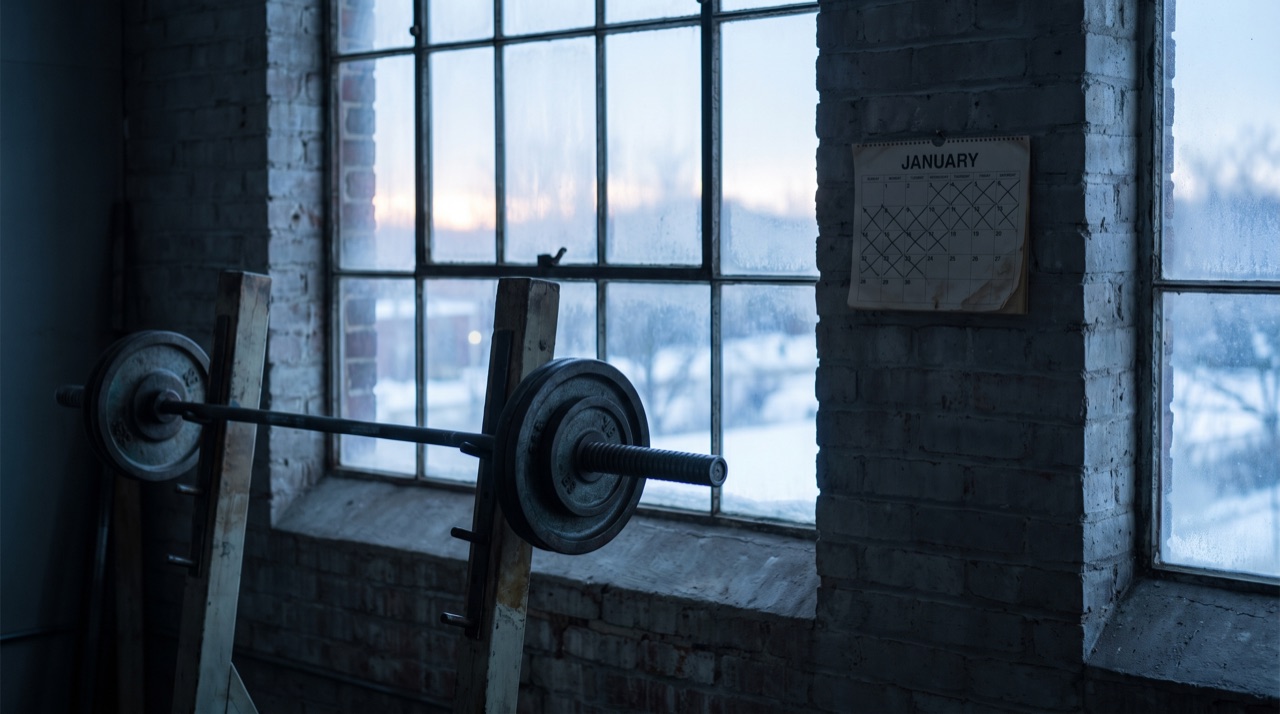
It is the first full week of October. Your alarm now goes off in the dark, your feed is full of people announcing their winter arc, and you are about to make the classic mistake: searching for the most brutal six-day split you can find, because 90 days of lock-in surely deserves a heroic programme.
It does not. If you are still deciding whether the arc itself is worth doing, read our guide to what the winter arc actually is first. This post is the training half: what to actually lift between now and January. And the honest answer is smaller and more boring than the videos suggest. The research on frequency, progression and even holiday breaks points the same way: a modest plan you can repeat through dark mornings and a week at your parents' house beats an ambitious plan you abandon in November.
The truth is stranger than the montage. Ninety days is not a test of intensity. It is about 36 sessions, and the only question that matters is whether they are connected.
Pick a split that survives dark mornings
Do the maths before you pick anything. October to the end of December is roughly 12 full weeks. At three sessions a week, that is 36 workouts. At four, it is 48. Miss two weeks across half-term, travel and Christmas, and your heroic six-day plan has quietly become a four-day one anyway. The split you choose should assume the bad weeks, not pretend they will not happen.
The evidence on what the split must deliver is clearer than the arguments about which split is best. Brad Schoenfeld, Dan Ogborn and James Krieger pooled 10 studies for Sports Medicine and found that training each muscle at least twice a week produced significantly more growth than hitting it once a week, even when the total weekly work was similar. The famous bro split, one muscle per day, fails that test on five days out of seven. A plan you only manage twice a week fails it entirely for most muscles.
Two structures pass it while surviving a winter schedule:
- Full body, three days a week. Every muscle gets trained three times, no session is precious, and a missed Monday just shifts the week. This is the right answer for most people doing their first serious 12-week block, and our workout split guide walks through it.
- Upper/lower, four days a week. Each half of the body gets hit twice, sessions stay under an hour, and the pattern is simple enough to run half-asleep at 6 a.m. If that sounds right, start with the upper/lower split for beginners.
Push/pull/legs works too, but run twice it wants six days, and six-day plans are the first casualty of December. If you love the structure, read push/pull/legs for beginners and run it three days a week on rotation instead.
Progress reps first, then weight
Here is the part the winter arc videos skip, and it is the part that decides the whole thing. A 12-week block only changes your body if the numbers move. The mechanism is progressive overload, and the good news is that the research says you have more than one lever.
Daniel Plotkin and colleagues tested this directly in PeerJ: 43 trained lifters, eight weeks, one group told to add weight to the bar over time, the other told to keep the weight fixed and add repetitions. Muscle growth was essentially the same in both groups. Adding a rep is progress. Adding weight is progress. What produced the results was that something, every week, went up.
So the scheme for your 12 weeks is simple. Pick a rep range, say 8 to 12. Start every exercise at the bottom of it. Add reps session by session until you hit the top of the range on all sets, then add a small amount of weight and drop back to 8. We cover the method in detail in progressive overload: reps first, then weight.
Shape the block loosely in thirds. Weeks 1 to 4, learn the movements and climb the rep ranges. Weeks 5 to 8, the weights start creeping up; take an easy week around week 6 or 7 if your joints ask for it. Weeks 9 to 12, you are lifting loads that were not on the bar in October, and that contrast is the arc.
None of this works untracked. If week 9 is not written down next to week 1, you cannot know whether you progressed, and the honest answer is that most people did not. This is exactly the failure Pocket Fit was built around: it logs every set, shows you last session's numbers while you train, and nudges the next target up for you.
Plan for the holidays, not around them
The winter arc's reputation for failure comes almost entirely from its last three weeks. Travel, family, parties. The assumption is that December undoes October. The research says it takes far less than people think to hold the line.
Barry Spiering and colleagues reviewed the minimum-dose literature for the Journal of Strength and Conditioning Research and found that in younger adults, strength can be maintained for weeks with as little as one session per week, down to a single hard set per exercise, provided the intensity stays high. You do not need your full programme in Christmas week. You need one honest session with heavy-enough work, and the block survives.
The food side of December is similarly overblown. Jack Yanovski and colleagues weighed 195 adults through the holidays for the New England Journal of Medicine and found the average gain was just 0.37 kg, far less than the participants believed they had gained. The catch was what happened next: the weight was never lost, and that small annual ratchet, not the Christmas dinner itself, is how holiday seasons add up over years. Eat the dinner. Just keep logging around it.
Practically, for weeks you travel:
- Drop to one or two full-body sessions, but keep the top sets heavy.
- Keep protein roughly where it was; let everything else relax for the day itself.
- Log the sessions you do rather than mourning the ones you miss.
This is where a plan on paper quietly dies and an adaptive one does not. When you miss a day, Pocket Fit's scheduler reshuffles the session into the rest of the week instead of dropping it, and the AI coach can rebuild a hotel-gym version of your workout from a sentence.
Bulk or cut during the winter arc?
The most searched question around winter arc training, and the one with the most folklore attached. Hoodie season says bulk. The thought of January says cut. The evidence says the aggressive version of either is the mistake.
Ina Garthe and colleagues split 24 elite athletes into two weight-loss rates for the International Journal of Sport Nutrition and Exercise Metabolism: roughly 0.7 per cent of body weight per week against 1.4 per cent. Both groups lost similar fat. But the slow group gained about 2 per cent lean mass and got measurably stronger while dieting, and the fast group essentially did not. Cutting hard and fast through your winter arc means arriving in January lighter but weaker, which defeats the point of 12 weeks of progressive training.
So the decision is simpler than it looks:
- Carrying fat you want gone before summer? Cut now, but slowly, around 0.5 to 0.7 per cent of body weight per week, with protein high. You have roughly two more diet windows before June; this is the quiet one. Our piece on calorie deficit and strength training covers how to hold your lifts while you do it.
- Already lean, want more muscle? Eat at maintenance or a small surplus and let the progression scheme do the work. Winter is the easiest time of year to eat enough.
- Not sure? Train hard, eat roughly at maintenance, and let the logging decide. If the bar is moving up and your weight is stable, you are recomposing, and that is a perfectly good winter arc.
Either way the input that matters is the same: enough protein, tracked loosely but honestly. Pocket Fit's Fuel tool does this without ceremony: scan a plate or barcode, check protein, carbs and fat, no red numbers and no shame.
Where the evidence runs thin
The honest caveats, because a winter arc built on overclaimed science is just January marketing in a hoodie.
The frequency meta-analysis pooled only 10 studies, mostly short and mostly on untrained or lightly trained people, and later work has found the twice-a-week advantage shrinks when total volume is matched carefully. Plotkin's rep-versus-load study ran eight weeks with 43 participants, which is small, and it does not tell you what happens over years. Spiering's minimum-dose findings are strongest for maintaining strength; muscle size and endurance may fade faster, and the clearest data comes from younger, already-trained groups. Garthe studied elite athletes with coaches and weighed food, not civilians in December. And nobody has run a randomised trial on "the winter arc" itself; the 90-day framing is cultural, not clinical.
None of that overturns the plan. It just sets the expectation: 12 weeks of tracked, progressive training produces real but modest change, visible to you in the mirror and obvious on the bar, not a cinematic transformation.
The arc is a line on a graph, not a montage
Put it together and the winter arc workout plan is almost embarrassingly simple. Three or four sessions a week, each muscle twice. Reps first, then weight, for 12 weeks. One heavy session holds the fort in any week that falls apart. A slow cut or a quiet lean gain, decided once and left alone. The montage version fails because it is built on intensity, which December taxes heavily. This version works because it is built on continuity, which December barely touches.
Continuity is a record-keeping problem, and that is the part Pocket Fit actually does. The programme is built for your days and equipment, every set is logged against last week's, the scheduler absorbs the missed days, and the Body budget keeps the four deposits that decide the arc, your workout, your streak, your sleep and your nutrition, in one running tally. If accountability is the part that usually breaks for you, read workout accountability without shame; the app is deliberately built on the forgiving version.
Our founder's winter arcs did not look like a montage either. Georgi went from 122 kg to winning first place at The Yard Games, losing 38 kg along the way, and the app exists because of the bad weeks, not the good ones. That story is here.
Winter arc workout plan: common questions
How many days a week should I train during the winter arc?
Three or four. The frequency research pooled in Sports Medicine found each muscle should be trained at least twice a week, which a three-day full-body plan or a four-day upper/lower plan delivers. Five and six-day plans work on paper but are the first thing December deletes.
Should I bulk or cut during the winter arc before summer?
If you have fat to lose, cut slowly now, around 0.5 to 0.7 per cent of body weight per week; in Garthe's study that rate let athletes gain about 2 per cent lean mass while dieting, where faster dieters did not. If you are already lean, eat at maintenance or a little above and chase the progression instead. The aggressive version of either is the real mistake.
What happens to my progress if I miss a week over Christmas?
Very little, if you do the minimum. Spiering's review found strength holds with as little as one session a week and one hard set per exercise, as long as the weight stays heavy. One honest hotel-gym or garage session in Christmas week protects 11 weeks of work.
Do I need to change my programme every few weeks?
No, and you should not. The adaptations come from repeating the same lifts while the numbers climb. Plotkin's trial found adding reps grew muscle just as well as adding load; both only work if you keep the exercises stable long enough to progress them. Twelve weeks on one plan is the feature, not the flaw.
Is 12 weeks actually enough to see results?
Yes, modestly. Expect noticeably heavier lifts, a visible change you will see before strangers do, and around 1 to 3 kg moved in the right direction depending on whether you cut or gained. What 12 weeks reliably builds is the bigger asset: a training habit that survives winter, which is the whole point of the arc.
References
- Schoenfeld BJ, Ogborn D, Krieger JW (2016). Effects of resistance training frequency on measures of muscle hypertrophy: a systematic review and meta-analysis. Sports Medicine, 46(11), 1689-1697. DOI: 10.1007/s40279-016-0543-8
- Plotkin D, Coleman M, Van Every D, Maldonado J, Oberlin D, Israetel M, Feather J, Alto A, Vigotsky AD, Schoenfeld BJ (2022). Progressive overload without progressing load? The effects of load or repetition progression on muscular adaptations. PeerJ, 10, e14142. DOI: 10.7717/peerj.14142
- Spiering BA, Mujika I, Sharp MA, Foulis SA (2021). Maintaining physical performance: the minimal dose of exercise needed to preserve endurance and strength over time. Journal of Strength and Conditioning Research, 35(5), 1449-1458. DOI: 10.1519/JSC.0000000000003964
- Garthe I, Raastad T, Refsnes PE, Koivisto A, Sundgot-Borgen J (2011). Effect of two different weight-loss rates on body composition and strength and power-related performance in elite athletes. International Journal of Sport Nutrition and Exercise Metabolism, 21(2), 97-104. DOI: 10.1123/ijsnem.21.2.97
- Yanovski JA, Yanovski SZ, Sovik KN, Nguyen TT, O'Neil PM, Sebring NG (2000). A prospective study of holiday weight gain. New England Journal of Medicine, 342(12), 861-867. DOI: 10.1056/NEJM200003233421206
Pocket Fit is a fitness and wellbeing app, not a medical device. It does not diagnose, treat or prevent any condition. Always consult a qualified healthcare professional before starting or changing a training or nutrition programme, and if you have persistent problems with sleep, pain or fatigue. Georgi, founder of Pocket Fit. He went from 122 kg to winning first place at The Yard Games, having lost 38 kg along the way.
Related articles
Free tools
Train smarter with Pocket Fit
Download the app