Turn your Apple Health sleep data into tomorrow's session
A watch can score last night out of 100, but the score changes nothing you do today. What helps is turning a run of short nights into one small instruction before you train: same plan, a little less volume.
6 min readUpdated March 2026
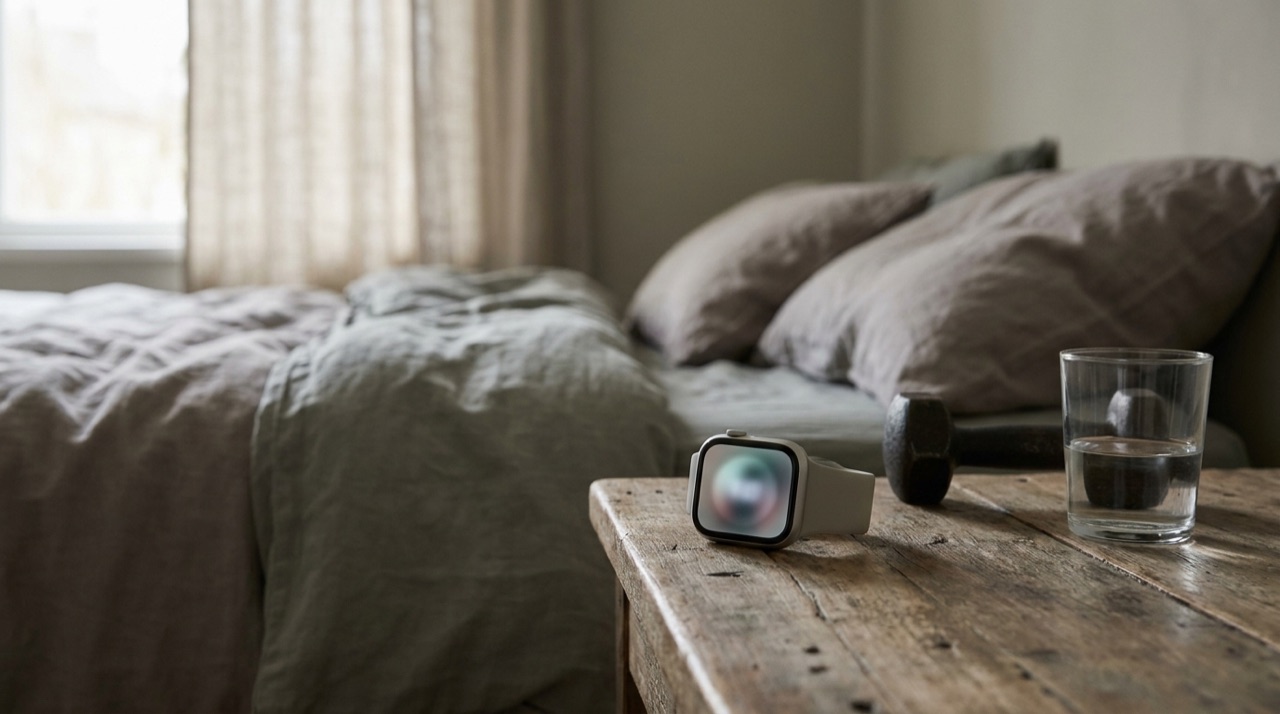
Your watch measured last night in detail and wrote it into Apple Health. How long you slept, how steady your bedtime was, how often you stirred. It handed you a score out of 100 and a tidy graph. Then you trained whatever you had planned. A number on a screen does not know it is meant to change your session, and at half past six, running on four hours, neither do you.
That is the odd shape of wearable fitness right now. The measuring is world class and the acting is missing. You are handed more detail about your own body than a sports lab had a generation ago. Then you are left alone with the numbers on the one morning it is hardest to make a good call.
What your Apple Health sleep score actually measures
Apple measures your night more thoroughly than most people notice. Every morning, your watch gives you a Sleep Score out of 100. Up to 50 points come from how long you slept, 30 from how consistent your bedtime was, and 20 from how little you woke. It is a clear, free read of the night, and it sits right there in Apple Health.
What it does not do is tell you what to train. The score describes the night and stops there. That is not a knock on Apple. The feature was built to measure, and it measures well. The decision about today is simply left with you, which brings us to the actual problem.
Measuring the night is not the same as changing the day
Every recovery tool on the market shares one limit. They tell you about last night, then hand the decision straight back to you. Whoop and Oura give you a recovery score and stop. Fitbod builds your session and never looks at your sleep at all. Across the whole category the score is the finished product, and what to do about it is your problem. That is the hardest part to get right when you are tired and short on patience.
So the data was never the missing piece. You already have more than enough of it. The missing piece is something turning it into a call before you start. It is the same gap that makes consistency matter more than an extra hour.
What Pocket Fit does after a run of short nights
Pocket Fit does the part the others skip. It works with the same sleep your watch already records. After a run of short nights it flags your next session and suggests you take the volume down a bit. Not a diagnosis. Not a red number. A heads-up, in training terms, before you start.
That is a smaller promise than an app that silently rewrites your workout, and it is the right one. You are the person training. A prompt that says ease off a little today leaves the call with you, where it belongs. And it is the difference between skipping the session and simply doing a lighter one, which after a bad week is the difference that actually matters.
The point is a lighter session, not a missed one
Put it together. Apple scores your Apple Health sleep and walks away. Pocket Fit reads the same night. After a bad run it tells you to go a little lighter, so the session that felt worst becomes one you still did. The plan does not break on a hard week. It bends, which is the whole argument for training through a rough patch rather than skipping it.
Sleep also sits inside your Body budget. That is Pocket Fit's simple running tally of what you put into your training, next to your workout, your streak and your nutrition. That keeps the night in the same place as the training it affects, rather than in a separate app you open once and forget. And when a session does get missed, the scheduler moves it into the rest of your week instead of dropping it.
I built the thing to tell me to go lighter, not to tell me I had failed. On a bad week those are very different messages, and I know which one kept me training. You can read how that started here.
Apple Health sleep training: common questions
Can Pocket Fit use my Apple Health sleep?
Yes. Pocket Fit works with your Apple Health sleep, the same sleep your Apple Watch records overnight. After a run of short nights it flags your next session and suggests you lower the volume a little. A rough patch of sleep becomes a lighter session rather than a skipped one.
Does Pocket Fit change my workout automatically when I sleep badly?
Not automatically. After a run of short nights Pocket Fit flags the session and suggests you take the volume down a bit. You make the change. The prompt is there so a bad run of sleep turns into a lighter day rather than a missed one.
What is a good Apple Health sleep score?
Apple scores each night out of 100, using sleep duration, bedtime consistency and how often you woke. There is no single right number, and it moves from night to night. Apple itself suggests watching the weekly trend rather than reading any one night as a verdict.
Is my watch accurate for tracking sleep?
Partly. Wearables tell sleep from wake very well, with Apple Watch sensitivity at or above 95%, and they track total sleep time and timing dependably. Deep and REM stage figures are much weaker night to night. Read stage numbers as a long-run trend, not a verdict on last night.
What is the Body budget in Pocket Fit?
The Body budget is Pocket Fit's running tally of what you put into your training. It scores four things you deposit: your workouts, your streak, your sleep and your nutrition. It keeps your sleep in the same place as the training it affects, rather than in a separate app.
References
- Apple Support. Track your sleep on Apple Watch and use Sleep on iPhone. https://support.apple.com/en-us/108906
- Schyvens A-M, Peters B, Van Oost NC, et al. (2025). A performance validation of six commercial wrist-worn wearable sleep-tracking devices for sleep stage scoring compared to polysomnography. SLEEP Advances, 6(2), zpaf021. DOI: 10.1093/sleepadvances/zpaf021
Pocket Fit is a fitness and wellbeing app, not a medical device. It does not diagnose, treat or prevent any condition. Always consult a qualified healthcare professional before starting or changing a training or nutrition programme, and if you have persistent problems with sleep, pain or fatigue. Georgi, founder of Pocket Fit. He went from 122 kg to winning first place at The Yard Games, having lost 38 kg along the way.
Related articles
Train smarter with Pocket Fit
Download the app