Sleep consistency and the weight on the bar
Across 45 studies, sleep loss made training feel significantly harder while barely changing how much force people produced - and that gap is the real case for sleep consistency.
10 min readUpdated March 2026
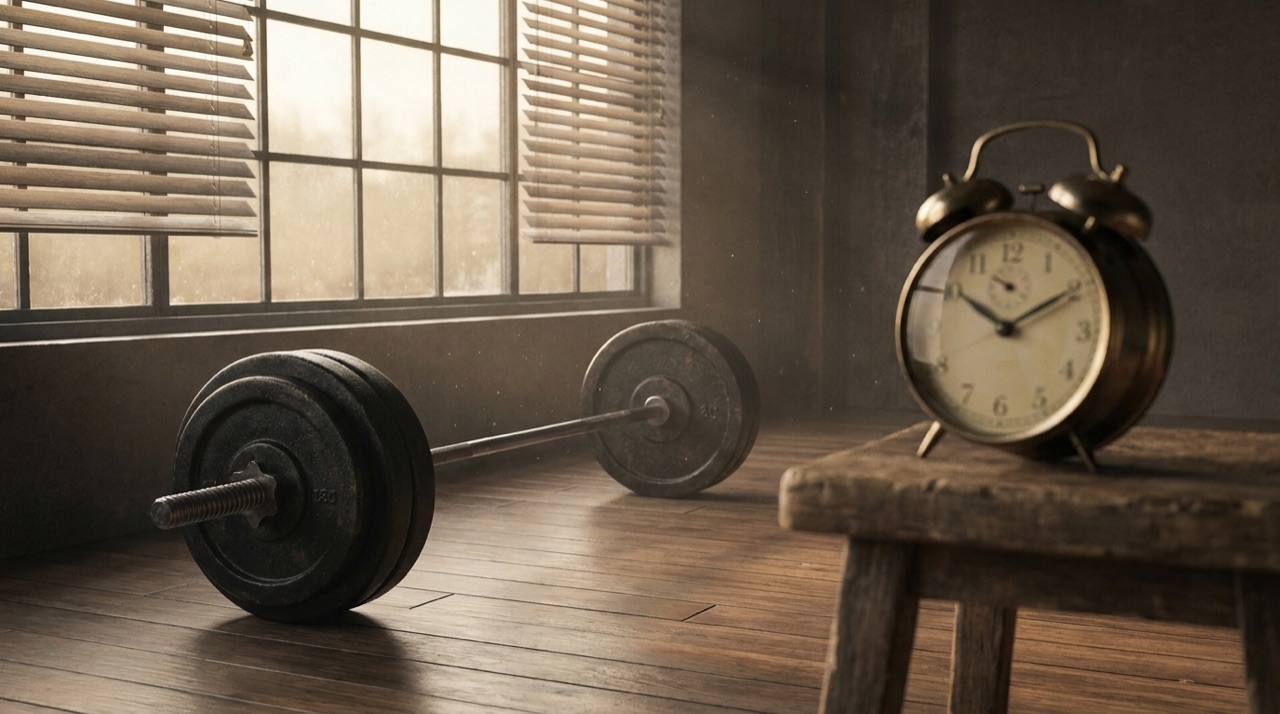
Your lifts have stopped improving and nothing in the programme has changed. What changed is your sleep consistency, and it is the one variable nobody wrote into the plan. Same session. Same working weight. Then that grinding third set, and you are already negotiating your way out of the last two.
That is not a motivation problem. It is a systems problem, and the research behind it is more useful than the version you have probably heard.
Most lifters assume a bad night wrecks the session. It does not. The truth is stranger, and it explains exactly why the weight stops going up.
What inconsistent sleep actually costs you
Inconsistent sleep is how you end up with runs of short nights. Bed at midnight, then half past one, then an early alarm on Thursday. Short nights are what the research has measured, so that is where the numbers start.
Knowles and colleagues reviewed 17 studies on sleep and muscle strength for the Journal of Science and Medicine in Sport. Their conclusion cuts against the folklore. Sustained sleep restriction impairs maximal force output. Crucially, it does so most clearly in compound, multi-joint movements: the squat, the bench, the deadlift, the press. Single-joint work holds up better.
Then a 2025 systematic review and meta-analysis in Frontiers in Physiology pooled 45 studies and put numbers on the size of the hit. Maximum force came out as the least affected outcome of the lot, at a standardised mean difference of just −0.24. Skill control (−0.87) and aerobic endurance (−0.76) took far bigger falls.
But one number moved the other way. Rating of perceived exertion rose (+0.51). The session felt significantly harder while actual output barely shifted.
So poor sleep barely changes how much you lift. What it changes is how hard the session feels. And that is the part that costs you, because the sets that feel worst are the sets you talk yourself out of. You are not more likely to fail the rep. You are more likely to not turn up.
Where the evidence is weak
The biggest gap is simple. Every study above ran deliberate sleep loss in a lab, usually over one night or a few in a row. Nobody followed a lifter through a year of shifting bedtimes and late finishes. So the research tells you what short sleep does. It does not tell you what a busy year does.
Then the numbers themselves. When the 2025 meta-analysis says maximum force barely moved, it measured isometric holds and grip tests rather than a barbell. The Knowles reviewers also rated their own 17 studies as moderate or weak for quality. So trust the direction of the finding more than the exact size of it.
Two last things. The hormone results on testosterone and cortisol came out contradictory, so we have built nothing here on them. If a sleep article rests its whole case on growth hormone, be careful with it. One author on the 2025 meta-analysis also works for a sleep-products company. That does not void the paper. It is still your business.
Sleep consistency beats forcing longer duration
Here the evidence changes shape, and it changes what you should do about it.
Windred and colleagues analysed roughly 60,977 UK Biobank participants who wore accelerometers for a week and were then followed for years. Sleep regularity, meaning the day-to-day consistency of when you fall asleep and when you wake, predicted all-cause mortality risk more strongly than sleep duration did.
Two things to be straight about before that lands. This is an observational cohort study, so it shows association rather than cause. Two of its authors also declare interests as co-founders of a circadian health company, which you should know before you weigh it.
Even so, the authors' own conclusion is the practical one. Keeping similar sleep times between days is likely a more feasible ask than devoting more of the day to sleep. Apple seems to have reached the same place independently. Its native Sleep Score awards 30 of its 100 points to bedtime consistency alone.
Now the part that matters. This is where most articles fail to be specific. Nobody has run a study showing that a regular bedtime adds kilos to your squat. What the strength research measures is restriction, meaning runs of short nights. And the most reliable way to stop having runs of short nights is to hold a window you can keep. That is the real case for sleep consistency, and it is a training case, not a wellness one.
It's important to still get enough sleep
A regular bedtime is not a licence to sleep less. Hold a perfect 5.5 hours every night and you have simply built a very consistent problem.
Nedeltcheva and colleagues ran the same 14-day calorie-restricted diet twice on the same ten adults, once with an 8.5-hour sleep opportunity and once with 5.5. Total weight lost came out roughly the same both times. What the body gave up did not. On short sleep, the fraction of weight lost as fat fell by 55%, while loss of fat-free mass rose by 60%.
The scale said the same thing. The body did something completely different.
That study is small: ten participants, fourteen days, and the authors say so themselves. Treat it as a strong signal from a tightly controlled design rather than a law of nature.
So sleep consistency works alongside enough sleep, not instead of it. And whatever you are doing, what you can hold for months beats what you can white-knuckle for a fortnight.
What your watch actually knows about your sleep
Here is where the category gets slippery, so we will not.
Validation studies that put consumer wearables against polysomnography, the clinical gold standard, find a clean split. The hardware reads sleep versus wake very well. Apple Watch sensitivity for sleep runs at or above 95%, with better than 90% agreement against polysomnography. Total sleep time is dependable. So is sleep and wake timing, which is exactly what sleep consistency is made of.
Stage data tells a different story. Against polysomnography, Apple Watch Series 8 scored a Cohen's kappa of around 0.53, which is moderate agreement at best. Specificity for spotting wake during the night landed between 29% and 52% across every consumer device tested. Even two trained human technicians scoring the same night agree only about 83% of the time. Sleep staging is genuinely hard to measure.
That gives us a rule we hold ourselves to. Build the argument on what the hardware measures well, which is how long you slept and when. Treat deep-sleep and REM figures as a trend across weeks, never as a verdict on last night. Your watch is good at knowing whether you were asleep. It is much less good at knowing which stage you were in.
The session you do not skip is the one that adds weight
Progressive overload is just accumulation. Add a little, log it, come back, add a little more, and the bar loads up over months because you kept turning up. Miss enough sessions and there is nothing to add to.
So put the evidence back together. A run of short nights takes some force off your compound lifts and leaves your isolation work largely intact. It makes everything feel a lot harder. And the session that feels worst is the one you skip, which is the only item on that list that stops the bar loading.
Sleep consistency, then, is a training variable. Treat it like one.
Pocket Fit already counts sleep as one of four deposits in your Body budget, alongside your workout, your streak and your nutrition. That puts it in the same ledger as your training instead of in a separate app you never open. Your streak rewards the thing the evidence points at, which is showing up on a schedule rather than heroically once a fortnight. And when a session does get missed, the scheduler reshuffles the week around it instead of letting it quietly disappear.
That last part matters more than it sounds. The real cost of a bad run of sleep is a missed session. Our job is to stop a missed session becoming a missed month.
Why I built it this way
I was 122 kg and I had no idea what to do on a gym floor. I lost 38 kg and ended up winning first place at The Yard Games. The sessions that got me there were not the ones where I felt fresh. They were the ones I did anyway, on a schedule, when the bar felt heavier than it was. You can read the whole story here.
Sleep consistency: common questions
Does one bad night ruin a workout?
No. The research that matters here is about consecutive nights of restriction, not one late Tuesday. After a single short night your maximal force barely moves, though the session will feel harder than it is. Train, drop the top set if bar speed looks off, and get back to your usual sleep window tonight.
Is more sleep or more regular sleep the better goal?
Regularity is the more achievable goal and it has strong evidence behind it. In roughly 60,977 UK Biobank participants, sleep regularity predicted all-cause mortality risk more strongly than sleep duration did. Its authors concluded that keeping similar sleep times is likely more feasible than finding extra hours. That study is observational, so it shows association rather than cause. Regularity is also not a reason to sleep less.
Can my watch tell me how well I slept?
Partly. Consumer wearables tell sleep from wake very well, with Apple Watch sensitivity at or above 95%, and they track total sleep time and timing dependably. Sleep-stage figures are much weaker night to night, reaching only moderate agreement with clinical polysomnography. Read stage numbers as a long-run trend, never as a verdict on last night.
Why do my big lifts suffer more than my accessories?
Compound movements demand the most from your nervous system. Review evidence shows sustained sleep restriction hits maximal force output most clearly in those multi-joint lifts, while single-joint work holds up better. After a rough week, that is a fair argument for keeping your accessory volume and staying conservative on the top end.
How does Pocket Fit use sleep?
Pocket Fit counts sleep as one of four deposits in your Body budget, alongside your workout, your streak and your nutrition. Your programme then adapts week to week from what you log. Miss a session and the scheduler reshuffles it into the rest of your week rather than dropping it. The aim is a plan that survives a bad week rather than a score that tells you off for having one.
References
- Knowles OE, Drinkwater EJ, Urwin CS, Lamon S, Aisbett B (2018). Inadequate sleep and muscle strength: implications for resistance training. Journal of Science and Medicine in Sport, 21(9), 959-968. DOI: 10.1016/j.jsams.2018.01.012
- Kong Y, Yu B, Guan G, Wang Y, He H (2025). Effects of sleep deprivation on sports performance and perceived exertion in athletes and non-athletes: a systematic review and meta-analysis. Frontiers in Physiology, 16, 1544286. DOI: 10.3389/fphys.2025.1544286
- Windred DP, Burns AC, Lane JM, Saxena R, Rutter MK, Cain SW, Phillips AJK (2024). Sleep regularity is a stronger predictor of mortality risk than sleep duration: a prospective cohort study. Sleep, 47(1), zsad253. DOI: 10.1093/sleep/zsad253
- Nedeltcheva AV, Kilkus JM, Imperial J, Schoeller DA, Penev PD (2010). Insufficient sleep undermines dietary efforts to reduce adiposity. Annals of Internal Medicine, 153(7), 435-441. DOI: 10.7326/0003-4819-153-7-201010050-00006
- Schyvens A-M, Peters B, Van Oost NC, et al. (2025). A performance validation of six commercial wrist-worn wearable sleep-tracking devices for sleep stage scoring compared to polysomnography. SLEEP Advances, 6(2), zpaf021. DOI: 10.1093/sleepadvances/zpaf021
Pocket Fit is a fitness and wellbeing app, not a medical device. It does not diagnose, treat or prevent any condition. Always consult a qualified healthcare professional before starting or changing a training or nutrition programme, and if you have persistent problems with sleep, pain or fatigue. Georgi, founder of Pocket Fit. He went from 122 kg to winning first place at The Yard Games, having lost 38 kg along the way.
Related articles
Exercise guides from this article
Browse the full exercise library →Train smarter with Pocket Fit
Download the app