Pocket Fit vs Freeletics: you can build muscle in a hotel room, but you cannot build a squat there
Across 21 trials, muscle growth was much the same whether the load was light or heavy. Maximum strength was not. That single split decides which of these two apps is worth your money.
14 min readUpdated August 2026
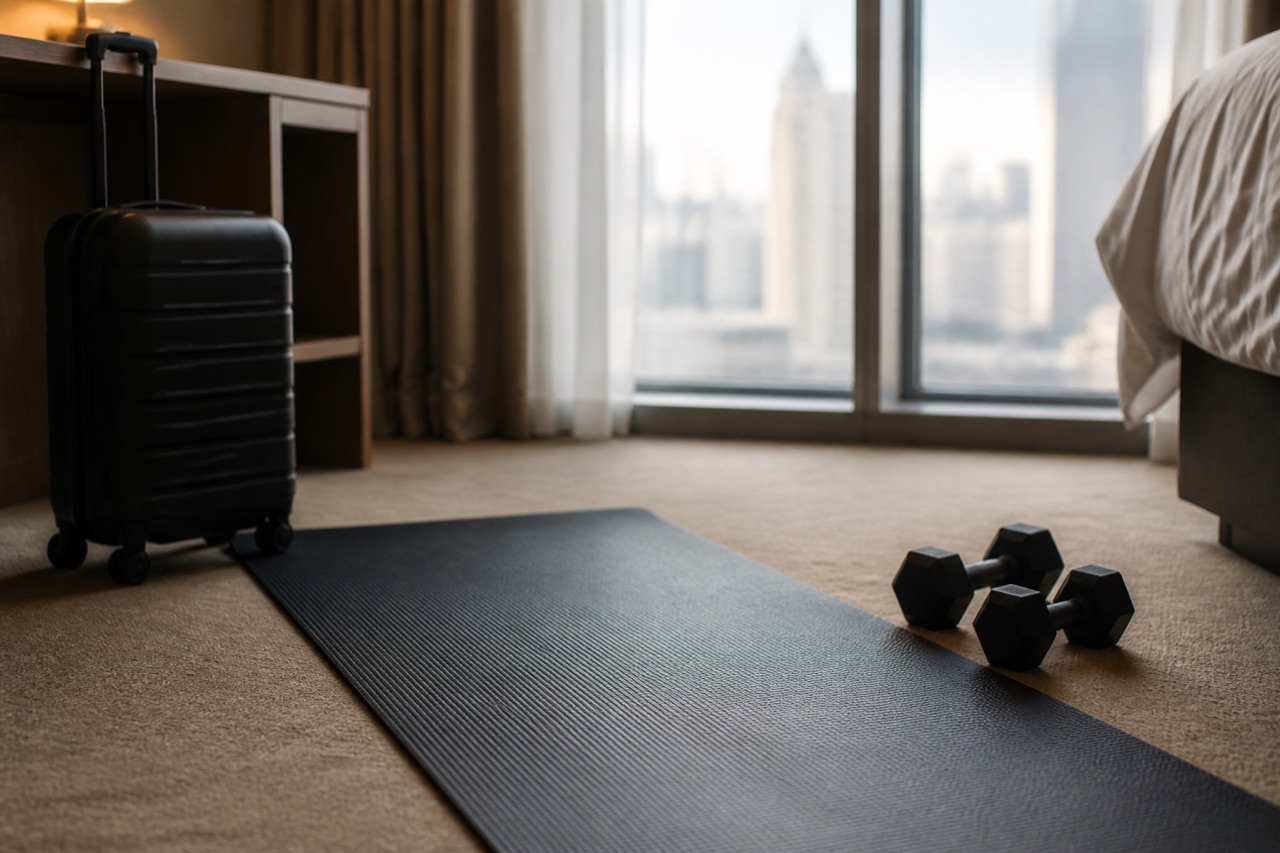
You are away for work again. The hotel gym is two treadmills and a rack of 8 kg dumbbells, and you want an app that will still give you something useful to do at seven in the morning. Or you are in the other situation entirely: you have a gym, a barbell and a number you want to move.
The reasonable assumption is that these are two versions of the same product, an AI coach that writes your training, so the choice comes down to interface, star ratings and price. It is not. These two are built around different rooms. Freeletics is designed for the case where your equipment is a floor, and has been for over a decade. Pocket Fit is designed for the case where there is a barbell and a schedule with dates on it.
What makes the decision awkward is that the research does not simply side with the barbell. It sides with the barbell for one outcome and not the other, and most people buying a fitness app have never separated the two. For the wider six app comparison, read the best AI personal trainer app first, and if the phrase "AI coach" still feels like it could mean anything, what an AI fitness app really is explains why. This is the narrow head to head.
Our bias, stated first
We make Pocket Fit. We sell a subscription. This article exists partly to sell it, so read every sentence about us as a claim from an interested party.
What we can do is make it checkable. Everything factual about Freeletics comes from its own website or its GB App Store listing, read in August 2026, with the sources at the end. We have not run a long term test of Freeletics and will not pretend we did.
Now the honesty tax. Freeletics is the best equipment-free training product in this category, and it is not close. It has been generating algorithmic sessions since long before that was a marketing requirement. Its listing describes an AI Coach that builds each workout around your goals, fitness level, preferences and setup, with over 700 exercises and, in the company's phrasing, one trillion workout combinations, and the GB App Store shows about 4.6 from roughly 10,500 ratings. The bodyweight and HIIT heritage is real, not something you fake with an equipment filter. If your training happens in hotel rooms, parks and living rooms, that is the whole product and it works.
The short answer
Choose Freeletics if your training has to survive whatever room you are standing in: you travel, you train outdoors, your equipment changes week to week, and you do not need a barbell number to go up on a schedule.
Choose Pocket Fit if you train in a gym and want a dated multi-week programme, a progression rule printed where you can argue with it, food in the same app, and a scheduler that moves a missed session instead of deleting it.
The dividing question is not which app is cleverer. It is which room you train in, and whether you need a specific number to rise.
Pocket Fit vs Freeletics side by side
Every Freeletics figure below is the company's own published number, read in August 2026, not something we measured.
Two of those rows need explaining, the price and the separate nutrition app, and both get a paragraph below.
Freeletics: a decade spent solving the room you are actually in
Freeletics starts from an assumption almost no other app in this bracket takes seriously: that you might have a hotel carpet, a park bench or a gym, and it should not fall apart when the answer is the carpet. Sessions arrive with warm-ups, cooldowns and mobility attached. Tell it you have twenty minutes and no kit, or that you would rather train upper body today, and it regenerates rather than sulking. It is a mature product with Apple Watch control and Apple Health writing.
Three limits, stated as fairly as we can.
The progression rule is not published. You cannot read what causes the work to get harder, so you can neither predict it nor audit it. That is our standing complaint about the whole category rather than about Freeletics specifically. It is still a trade: when nothing has felt harder for three weeks, an unpublished rule leaves you unable to tell "the algorithm is being cautious" from "I stopped hitting the targets" from "I have slept badly for a fortnight".
The price is not published either. You get the shape of the subscriptions, six auto-renewing options across two bundles and three billing periods, but not the amounts, and the UK App Store shows several in-app purchase price points that we will not match to those bundles by guessing. The 14-day money-back guarantee on the Coach is the practical way to find out what you will pay.
Nutrition is a second app. The Nutrition Coach sits in the separate Freeletics Nutrition app rather than next to your session. That matters more than it sounds, because a stall you cannot see food against can only be read as a training failure. It is frequently an eating failure.
None of that makes it a bad product. It makes it a product with a different centre. Weighted exercises and gym machines are in the Coach, so the barbell is not locked out, but a dated week built around a squat and a target you can see coming is not what it is for.
Pocket Fit: a gym programme with the rule printed on it
Ours works the other way round. The programme comes first and each session is an output of it.
A dated multi-week programme. Your goal, days, difficulty, equipment, split and injuries become a scheduled week of sessions, then real exercises, each with a written reason. You read the whole thing before your first set, and it updates week to week from what you log.
A progression rule you can read. Reps first inside the prescribed range, then the smallest weight increment your equipment allows, and the plan only changes around you off a confirmed plateau, two misses rather than one, because a single bad set is more often a bad night than a real ceiling. The mechanics are in reps first, then weight. You are allowed to disagree with it, which is the point of publishing.
Injuries in your own words. You type what is wrong as free text and it becomes an input to exercise selection.
Fuel. Scan a plate or a barcode, check protein, carbs and fat, no red numbers and no shame. Same app, same membership, so a stalled lift is diagnosable.
The scheduler, the AI coach and the body budget. A missed session is reshuffled into the rest of the week rather than quietly disappearing. The rack is taken, your shoulder is unhappy, you have 30 minutes instead of 60: one sentence to the AI coach rebuilds the session from the same rules engine. The body budget keeps one tally across four deposits, your workout, your streak, your sleep and your nutrition.
If your real question is which app writes the better single gym session rather than the better week, that comparison is Pocket Fit vs Fitbod.
What the evidence says: load decides strength, not size
Here is the study that settles this comparison, and it is not about algorithms at all.
Schoenfeld, Grgic, Ogborn and Krieger pooled 21 studies for the Journal of Strength and Conditioning Research, comparing low-load training at 60% of one-rep max or below against high-load training above it, in protocols lasting at least six weeks where every set went to momentary muscular failure. The result splits cleanly: gains in one-rep max strength were significantly greater with heavy loads, while changes in muscle size were similar across the whole loading spectrum. Isometric strength showed no significant difference.
That cuts both ways.
If your goal is size, the Freeletics bodyweight and HIIT heritage is not a compromise you tolerate for convenience. Light loads taken close to failure grow muscle about as well as heavy ones, and an app that gets you training in a hotel room beats a barbell programme you skip because there is no barbell.
If your goal is a number, load is not optional. Maximal strength came from heavy work, and no amount of clever session generation substitutes for it. That is the case for a gym-first programme with a published rule about when the weight goes up, because "heavier over time" has to be an instruction rather than a hope.
Where the evidence and our claims run thin
There is no head to head trial. Nobody has compared our rules engine against the Freeletics Coach in a randomised study. Anyone claiming their engine is proven superior to a competitor's is telling you something they cannot know, us included.
The load meta-analysis has conditions attached. Every set in those protocols went to momentary muscular failure, and light loads only match heavy ones for growth when taken that close to the limit. Twenty-one mostly short studies is good evidence rather than strong evidence.
Our own framing flatters us. Weighted exercises, gym machines and cardio are all in the Freeletics Coach, so the "no barbell" line above describes where the design is centred, not a limit the company states.
The fairest point against our thesis. Michie and colleagues meta-regressed 122 evaluations covering 44,747 people for Health Psychology and found a pooled effect of 0.31, with self-monitoring explaining more of the variation between studies than any other technique, rising to 0.42 against 0.26 when combined with another self-regulation technique. Logging in an app you enjoy opening does something real. Our claim is that a published, gym-first programme is the better bet for a lifter, not that Freeletics users get nothing.
And we are the newer product, with a rules engine nobody outside this company has audited, which is what we criticise other apps for.
Who should buy which
Buy Freeletics if your equipment is unpredictable, or reliably nothing at all: travel, outdoor training, a living room, conditioning alongside strength. Start on the permanently free tier and only pay for the Coach if the free version already has you training.
Buy Pocket Fit if you train in a gym and want the barbell numbers to move on purpose: a dated programme you can read in advance, a progression rule you can check, injuries handled in plain English, food in the same app, and a scheduler that rescues the week when Wednesday collapses.
Buy both if you are a gym lifter who travels one week in four. They are not solving the same problem. If you are weighing either against paying a real person, that trade is in can an AI fitness app replace a personal trainer.
Put it together
Both answers are legitimate. Freeletics answers "what can I do in this room, right now, with nothing" better than anyone else here. Pocket Fit answers "what is my week, and what has to get heavier in it": dated sessions, reps before weight and weight only off a confirmed plateau, a scheduler that moves a missed Wednesday instead of erasing it, an AI coach that rebuilds a session from one sentence, Fuel for the food, and a body budget across workouts, streak, sleep and nutrition. Hold on to the 21-study split: size travels, strength does not.
The founder note, because it explains the design. Georgi built Pocket Fit after going from 122 kg to winning first place at The Yard Games, having lost 38 kg along the way. The app is not shaped by the good weeks. It is shaped by the bad ones, the missed sessions and the plans rebuilt in a car park. That is our story, and why the rule is printed and the scheduler forgives.
Pocket Fit vs Freeletics: common questions
Is Pocket Fit better than Freeletics?
Neither is better in general, because they are built for different rooms. Freeletics is the strongest equipment-free and travel product here, at about 4.6 from roughly 10,500 GB ratings. Pocket Fit is gym-first, with a dated programme, a published progression rule and food included. If your equipment is unpredictable, Freeletics. If you want a barbell number to rise on a schedule, us.
How much does Freeletics cost?
We will not give you a single figure, because Freeletics does not publish one on the pages we read. It publishes the structure: six auto-renewing subscriptions, Training or Training and Nutrition, over 3, 6 or 12 month periods, with a 14-day money-back guarantee. The UK App Store shows several in-app purchase price points, which we will not map to those bundles by guessing, so check the store before you pay. Pocket Fit is £9.99 a month or £59.99 a year, food included.
Is Freeletics free?
Partly, and more generously than most. The free version contains 34 HIIT bodyweight workouts and over 100 exercises permanently. The AI Coach, the 700-plus exercise library and the training plans sit behind the subscription. Pocket Fit is also free to start with no card.
Can you build muscle with Freeletics bodyweight workouts?
On the evidence, yes. That 21-study meta-analysis found muscle growth was similar across the loading spectrum, from 60% of one-rep max and below up to heavy work, so bodyweight training is not automatically a lesser choice for size. The condition is that those sets went to momentary muscular failure, which is harder to do honestly in a hotel room than it sounds.
Which is better for gym and barbell training?
Pocket Fit, and here the evidence is on our side rather than only our opinion. One-rep max strength gains in that meta-analysis were significantly greater with heavy loads, so if a number on the bar is the goal you need a programme that loads it deliberately. Ours does that on a published rule: reps first inside the range, then the smallest increment your equipment allows.
References
- Freeletics official website, including the AI Coach description and how it adapts to your goals, fitness level, equipment and location. freeletics.com Accessed August 2026.
- Apple App Store (GB). Freeletics: HIIT Home Workouts, Freeletics GmbH: the free version's 34 HIIT bodyweight workouts and 100-plus exercises, the Coach's 700-plus exercises and "1 trillion workout combinations" claim, the six auto-renewing subscription options across 3, 6 and 12 month periods, the 14-day money-back guarantee, and the rating count. Checked August 2026. apps.apple.com
- Apple App Store (GB). Freeletics Nutrition, the separate app housing the Nutrition Coach. Checked August 2026. apps.apple.com
- Schoenfeld BJ, Grgic J, Ogborn D, Krieger JW (2017). Strength and Hypertrophy Adaptations Between Low- vs. High-Load Resistance Training: A Systematic Review and Meta-analysis. Journal of Strength and Conditioning Research, 31(12), 3508-3523. DOI: 10.1519/JSC.0000000000002200
- Michie S, Abraham C, Whittington C, McAteer J, Gupta S (2009). Effective techniques in healthy eating and physical activity interventions: a meta-regression. Health Psychology, 28(6), 690-701. DOI: 10.1037/a0016136
- Apple App Store. Pocket Fit (Pocket Squats), listing, checked August 2026. apps.apple.com/gb/app/pocket-squats/id6748518785
- Pocket Fit pricing, as published on pocket-fit.app/pricing
Pocket Fit is a fitness and wellbeing app, not a medical device. It does not diagnose, treat or prevent any condition. Always consult a qualified healthcare professional before starting or changing a training or nutrition programme, and if you have persistent problems with sleep, pain or fatigue. Georgi, founder of Pocket Fit. He went from 122 kg to winning first place at The Yard Games, having lost 38 kg along the way.
Related articles
Free tools
Train smarter with Pocket Fit
Download the app