Sleep and muscle growth: why a bad night is not a rest day
Sleep loss slows the rate at which your body builds muscle, but the strongest study on sleep and muscle growth found that training through a bad week held that rate steady.
8 min readUpdated March 2026
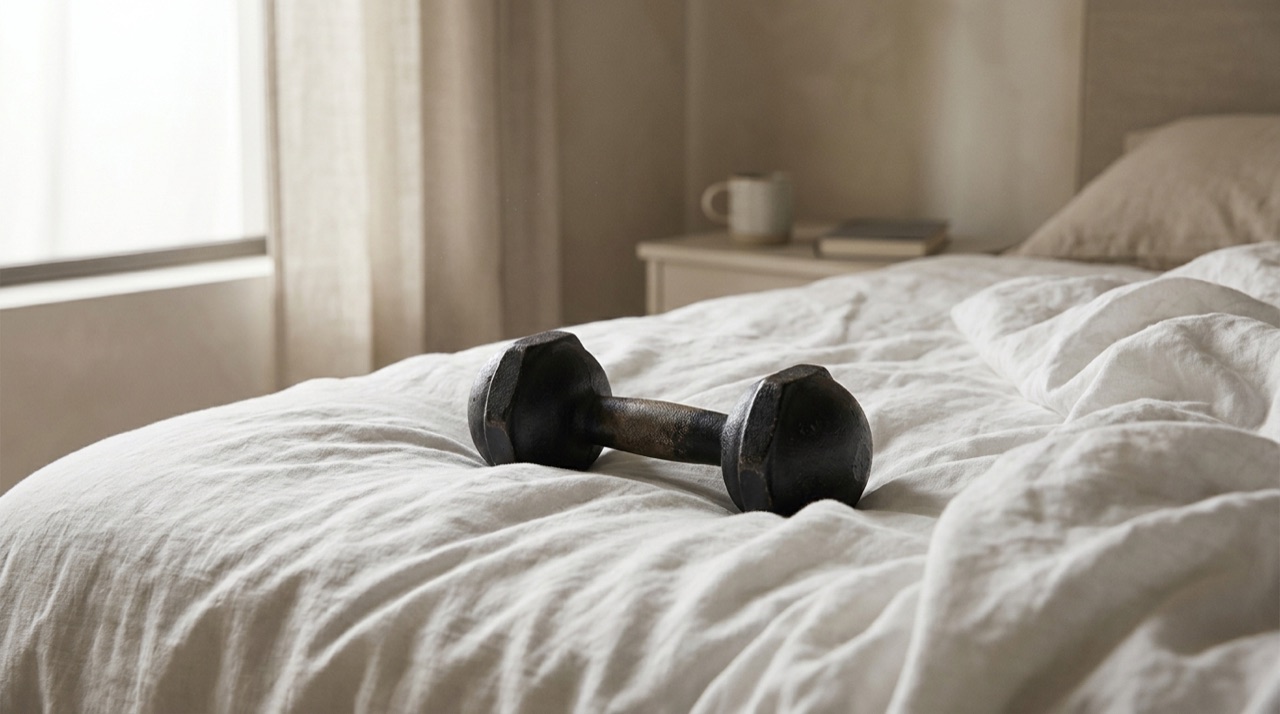
Four hours on Tuesday. Five on Wednesday. By Thursday you are staring at your training plan wondering whether there is any point, because everything you have ever read about sleep and muscle growth says you build it in bed. So the reasonable-sounding conclusion arrives on its own. Skip the session. Sleep instead. Come back when you have recovered.
That conclusion is wrong, and the research says so fairly clearly.
What sleep loss does to muscle building
Muscle gets built through a process called muscle protein synthesis. Training is the signal that switches it up. Food supplies the bricks. And the rate at which your body lays them is measurable, in a lab, from a muscle sample.
Lamon and colleagues did exactly that. They took 13 healthy adults, kept them awake for one entire night, and compared their muscle protein synthesis against a night of normal sleep. The rate dropped by 18%. Everyone ate the same meal, so this was not about eating less. The muscle simply did less with the same protein.
Saner and colleagues then ran the version closer to real life. Five nights, four hours in bed each night. Muscle protein synthesis in the sleep-restricted group came out around 19% lower than in the group sleeping normally.
So the folk wisdom is half right. Something important does happen after you leave the gym, and short sleep genuinely slows it down.
Why bad sleep is not a rest day
Saner's study had a third group, and almost nobody writes about it.
That group did the same five nights of four-hour sleep. But they also exercised during the week. Their muscle protein synthesis did not drop. It came out at normal levels, matching the group who slept properly.
Read that again. The building process that sleep loss slows down was held at full speed by training. Not by sleeping more, which they could not do. By turning up.
This flips the standard advice on its head. Your watch says you are under-recovered, your recovery app suggests a rest day, and the actual evidence suggests that the session is one of the few things holding the line while your sleep is a mess. The gym is not the thing draining you that week. It is the thing defending you.
Two caveats, because this finding is doing a lot of work. Saner used high-intensity intervals on a bike, not barbell training, so nobody has yet run this study with lifters. And the groups were small, young and male.
The testosterone story is weaker than you have been told
Nearly every article about sleep and muscle growth arrives at the same place. Sleep badly, and your testosterone collapses.
Here is what the evidence says. Su and colleagues pooled 18 studies covering 252 men. Short-term partial sleep loss had no significant effect on testosterone at all. Total sleep deprivation, meaning a full night with none, did lower it.
Now look at where the scary numbers come from. Lamon's 24% testosterone drop came from a night of zero sleep. That is a laboratory condition. You are not pulling all-nighters every week. You are getting five and a half hours, which is the condition where the testosterone effect stops showing up.
So the frightening number comes from a study design that does not describe your life. In the pooled data, partial sleep loss did not move testosterone at all. What slowed was the building machinery, and it slowed without any symptom you could feel.
That is the useful version, and it is the one nobody sells you, because a hormone scare makes a better headline than a protein-synthesis rate.
What this means for your week
Train. Then adjust what you ask of the session.
Keep the sessions in the diary. The evidence for skipping them is thin, and the evidence for keeping them is a paper in the Journal of Physiology. What should change is ambition, not attendance. A rough week is a poor week to chase a personal best, and a perfectly good week to do the work.
Eat the protein you would normally eat. Lamon's participants ate an identical meal and still built less, which means short sleep does not give you licence to eat less, and it does mean the food matters more.
And fix the sleep where you can fix it, knowing the fix is slower than the damage.
Where sleep and muscle growth research runs out
Every study here is small. Thirteen people in one, three modest groups in the other. That is what happens when a design requires muscle biopsies and a controlled night in a sleep laboratory. These are careful studies, not big ones, and they should be read that way.
None of them measured muscle actually being gained. They measured the rate of protein synthesis over hours or days, which is the best available proxy and is not the same thing. A short-term rate is a strong clue about long-term growth. It is not proof of it.
Saner's team also could not explain their own result. The molecular switches they expected to move, the ones that usually regulate protein synthesis, did not move. So the effect is real and the mechanism is open.
None of that changes the practical answer. It just means you should hold it a little more loosely than the internet will.
Training is the signal, sleep is a condition
You do not get stronger while you sleep instead of while you train. That is the most repeated claim about sleep and muscle growth anywhere on the internet, and it has the order backwards. Training is what tells your body to build anything at all, and the research above shows that training keeps working even when your sleep does not.
Sleep is a condition that lets the build run at full speed. Take the condition away and the build slows by roughly a fifth. Take the training away and there is nothing to build.
So on a bad week, protect the session first.
Pocket Fit is designed around that order. Your programme updates week to week from what you log, so a lighter week teaches it something rather than breaking it. The scheduler reshuffles a session you miss into the rest of your week instead of dropping it. And sleep sits inside your Body budget as one of four deposits, next to your workout, your streak and your nutrition, which is the point: sleep belongs in the training plan, not in a separate wellness app you check once and forget.
Nobody loses 38 kg on a run of perfect weeks. I did it on the bad ones, with a plan that bent instead of breaking, and that is the app I ended up building. You can read how that started here.
Sleep and muscle growth: common questions
Does muscle really grow while you sleep?
Muscle grows through protein synthesis, which runs for many hours after a session and does not stop at bedtime. Sleep loss slows that rate. One night without sleep reduced it by 18% in a controlled crossover study, and five nights of four-hour sleep reduced it by roughly 19%.
Should I skip the gym after a terrible night?
Skipping is rarely the better option. In the Journal of Physiology study, people who exercised through five nights of four-hour sleep held their muscle protein synthesis at normal levels, while those who only rested did not. Keep the session and lower your ambition for it instead.
Will poor sleep tank my testosterone?
Probably not, if you are simply short on sleep rather than skipping it entirely. A meta-analysis of 18 studies in 252 men found short-term partial sleep loss had no significant effect on testosterone. Only total sleep deprivation, meaning a full night with none, reliably lowered it.
How much protein should I eat when sleep is short?
Eat what you would normally eat. In the sleep-deprivation study, everyone consumed the same protein and the sleep-deprived group still built less muscle from it. Short sleep does not reduce what your body needs. It reduces what your body does with it.
Does Pocket Fit change my plan when I am tired?
Pocket Fit builds your programme around your goal, equipment and schedule, then updates it week to week from the sessions you log. Miss one and the scheduler moves it rather than dropping it. Sleep also sits in your Body budget as one of four deposits, alongside your workout, streak and nutrition.
References
- Lamon S, Morabito A, Arentson-Lantz E, Knowles O, Vincent GE, Condo D, Alexander SE, Garnham A, Paddon-Jones D, Aisbett B (2021). The effect of acute sleep deprivation on skeletal muscle protein synthesis and the hormonal environment. Physiological Reports, 9(1), e14660. DOI: 10.14814/phy2.14660
- Saner NJ, Lee MJC, Pitchford NW, Kuang J, Roach GD, Garnham A, Stokes T, Phillips SM, Bishop DJ, Bartlett JD (2020). The effect of sleep restriction, with or without high-intensity interval exercise, on myofibrillar protein synthesis in healthy young men. The Journal of Physiology, 598(8), 1523-1536. DOI: 10.1113/JP278828
- Su L, Zhang SZ, Zhu J, Wu J, Jiao YZ (2021). Effect of partial and total sleep deprivation on serum testosterone in healthy males: a systematic review and meta-analysis. Sleep Medicine, 88, 267-273. DOI: 10.1016/j.sleep.2021.10.031
Pocket Fit is a fitness and wellbeing app, not a medical device. It does not diagnose, treat or prevent any condition. Always consult a qualified healthcare professional before starting or changing a training or nutrition programme, and if you have persistent problems with sleep, pain or fatigue. Georgi, founder of Pocket Fit. He went from 122 kg to winning first place at The Yard Games, having lost 38 kg along the way.
Related articles
Free tools
Train smarter with Pocket Fit
Download the app